Snow Gum Tree: Bark, Leaves and Identification Guide
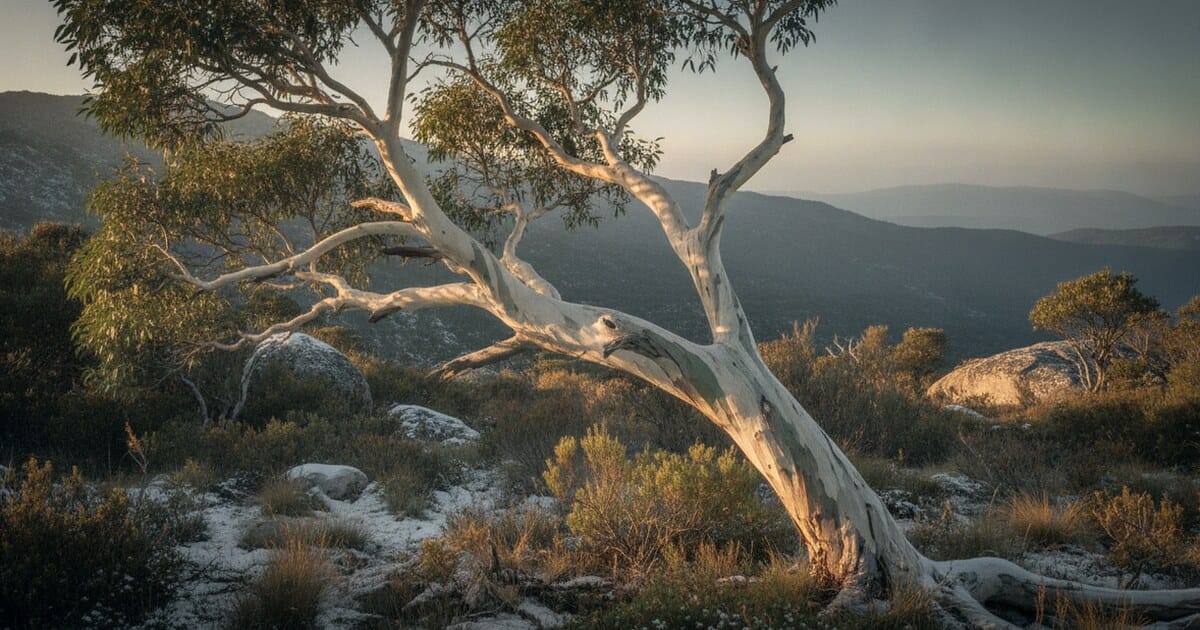
Walk through any Australian alpine woodland above 700 metres and you’ll run into snow gum sooner or later. Eucalyptus pauciflora is hard to miss: the bark cycles through white, cream, grey and green on a single trunk, and the tree often leans or twists at angles that betray decades of wind and snow pressure. Snow gums grow where most eucalypts can’t survive, holding the alpine treeline from Tasmania to the southern edge of Queensland. The subspecies that pushes highest, E. pauciflora subsp. niphophila, survives temperatures that would kill most Australian trees outright. If you’re walking the Snowy Mountains, the Victorian Alps or any high-country plateau in the southeast, knowing how to read snow gum bark and foliage will anchor a lot of what you’re looking at.
Snow gum (Eucalyptus pauciflora) has smooth, mottled bark that peels in ribbons, exposing patches of white, cream, grey and green on the same trunk. Adult leaves are glossy, waxy and 5 to 20 cm long. The tree grows above 700 m altitude across Tasmania, Victoria, NSW and the ACT, and is Australia’s most cold-tolerant eucalyptus.
What Does a Snow Gum Tree Look Like?
Snow gum has one of the most distinctive silhouettes in Australian alpine bush. The trunk is frequently crooked and multi-stemmed, pressed into contorted shapes by decades of wind and snow load. At lower elevations (700 to 1,000 m), it grows more upright, reaching 12 to 30 m. Near the treeline, the same species squashes down to 2 to 7 m, with wide, low branches that shrug off snow rather than break under it.
The bark is the single fastest ID feature. As the tree matures, the outer bark peels away in long ribbons, uncovering smooth new bark underneath. That new bark starts olive and yellow, fades through cream and white, then weathers to grey. At any moment, one trunk carries all these tones at once: patches of white, cream, grey, green and the occasional orange-pink flush where bark has just shed. Young branches are a glossy deep red before they bleach out.
Eucalyptus pauciflora belongs to family Myrtaceae and includes 6 recognised subspecies across eastern Australia. The species grows in subalpine woodland above 700 m (2,300 ft), from Tasmania north through Victoria (Australian Alps, Bogong High Plains) and New South Wales (Snowy Mountains, Blue Mountains) to the southern ranges of Queensland. Height runs 12 to 30 m at lower elevations and drops to 2 to 7 m at the alpine treeline, where wind and snow compact the form into a low, spreading shape. Subspecies niphophila (alpine snow gum) is restricted to the Snowy Mountains, ACT and Victorian Alps (Mt Hotham, Mt Bogong, Bogong High Plains) and survives temperatures as low as -23°C (-9°F), making it the most cold-tolerant eucalyptus in the world. All subspecies form a lignotuber, a woody base swelling that stores carbohydrates for resprouting after fire. Flowers appear in umbels of 9 to 15, white, October to January.
One feature to look for beyond the bark: insect scribbles. Longicorn beetle larvae (family Cerambycidae) tunnel just beneath the outer bark before it sheds, leaving winding channels etched into the smooth surface below. These scribble tracks are common on older stems and make snow gum bark look almost handwritten.
Snow Gum Bark: How It Changes With Age
Young snow gums carry olive to yellow-green bark on new growth. Over one or two seasons, that bark bleaches through cream to white, then weathers soft grey. Older sections develop pale orange or pink tints where sunlight catches a freshly exposed patch. The result on a mature tree is a mosaic: no two bark panels the same age, no solid colour running across the full trunk.
Several other eucalypts have smooth, pale bark, so location and form help narrow things down before you get close. A twisted or leaning trunk on a ridge or exposed slope above 700 m in southeastern Australia puts snow gum at the top of the list. The bark sheds in long ribbons on snow gum, rather than in tight flakes or thick papery sheets, which is a useful tactile clue when you can reach the tree.
Ribbon gum (Eucalyptus viminalis) produces the longest bark ribbons of any Australian eucalypt, far longer than snow gum’s, often hanging from upper branches in tangled strips. Snow gum’s ribbons fall clear when they peel. That hanging-ribbon behaviour is a reliable separator between the two species.
Snow Gum Leaves, Flowers and Fruit
Adult leaves are glossy, thick and waxy, measuring 5 to 20 cm long and 1.5 to 3 cm wide. They’re lance-shaped to elliptical, with a short stalk and side veins that run roughly parallel to the midrib. That parallel vein pattern is what separates Eucalyptus pauciflora from true ash eucalypts, like alpine ash (E. delegatensis), which have randomly angled veins. The leaf surface is packed with oil glands, making it glisten in low-angle light.
Juvenile leaves look quite different. They’re bluish-grey, broader and often coated in a waxy bloom that gives whole young plants a blue-grey tone. This juvenile phase lasts 2 to 4 years, so young snow gums look little like the glossy adult version.
Flowers appear from October to January in umbels of 9 to 15 white blooms. The species name pauciflora means “few-flowered” in Latin, which is ironic given how abundantly the tree flowers. The name stuck from an early botanical misidentification. Fruit follows as small capsules: cup-shaped to hemispherical, 6 to 10 mm long and wide, often with a glaucous (waxy) coating that’s especially pronounced in the alpine subspecies.
Snow Gum Subspecies Guide
Six subspecies of Eucalyptus pauciflora are currently recognised, each occupying a different altitude band or region.
subsp. pauciflora is the widespread form found across subalpine woodland between 700 and 1,400 m. It’s the tallest, reaching 12 to 30 m, with adult leaves up to 20 cm long. This is what most people encounter when walking the tablelands of NSW, VIC or TAS.
subsp. niphophila (alpine snow gum) is the most widely planted in gardens globally, prized for cold hardiness down to -23°C (-9°F). It’s smaller than the main form (leaves 5 to 10 cm), with consistently waxy branchlets, buds and fruit. Restricted to the highest tree-capable altitudes: Snowy Mountains (NSW), Bimberi (ACT), Mt Hotham, Mt Bogong and the Bogong High Plains (VIC). The name niphophila is ancient Greek for “snow-loving.”
subsp. debeuzevillei (Jounama snow gum) has strongly angular mature buds. Found in a restricted area of the Snowy Mountains near Jounama Creek.
subsp. hedraia is identified by larger, glaucous, sessile (unstalked) buds. Found in the southern tablelands of NSW.
Subspecies acerina and parvifructa differ in fruit and bud dimensions and occupy further restricted ranges in the alpine zone.
Snow Gum vs Similar Trees
Three species generate the most confusion when working through smooth-barked eucalypts in the high country.
Ribbon gum (E. viminalis): Also has smooth, pale, peeling bark, but ribbon gum’s bark hangs in long tangled strips from upper branches, much longer and more chaotic than snow gum’s clean ribbon shedding. Ribbon gum grows at lower altitudes (200 to 900 m) and has narrower adult leaves, typically 0.7 to 1.5 cm wide compared to snow gum’s 1.5 to 3 cm. Altitude alone separates most sightings.
Candlebark (E. rubida): Smooth, white to cream bark, and also a high-altitude species. The key separation: candlebark grows taller (up to 40 m), more upright, and its leaves carry randomly angled veins rather than snow gum’s parallel side veins. Candlebark also lacks the insect scribbles common on mature snow gum stems.
Alpine ash (E. delegatensis): Grows in the same elevation bands but is easy to separate. Alpine ash keeps rough, stringy fibrous bark on the lower trunk even when the upper bark is smooth. Snow gum’s bark is smooth from the ground up, with no fibrous base.
Both spotted gum and river red gum are smooth-barked Australian eucalypts, though they’re lowland species that don’t overlap with snow gum’s alpine range. Spotted gum develops a dimpled bark texture during shedding; river red gum’s colour patches tend toward tighter, rounder shapes rather than snow gum’s flowing multi-tone bands.
Identify Snow Gum With Tree Identifier
If you’re not sure whether you’re looking at snow gum or one of its look-alikes, the Tree Identifier app can confirm the species from a single photo. Photograph the bark, a leafy branchlet and, if available, a cluster of gumnuts, then let the app match against its species database. Results come back in seconds with confidence scores and habitat details. The app works in offline mode, so it’s practical on remote alpine walks where mobile signal cuts out.
You can also try the free web tool at treeidentifier.app/tools/tree-identifier before you head out, or use it at the trailhead with a photo you’ve already taken. For broader Australian tree coverage, the banksia and melaleuca guides cover two other species that share eastern Australia with snow gum across a range of different habitats and elevations.
Frequently Asked Questions
What is the fastest way to identify a snow gum?
Look at the bark: smooth and mottled, with patches of white, cream, grey, green and yellow on the same trunk, peeling in long ribbons. Young branches are glossy red before they bleach. Above 700 m in southeastern Australia, that combination of colour patchwork, ribbon shedding and red young growth points directly to snow gum.
How cold can snow gum survive?
The main species handles hard frosts and regular snowfall through winter. Subspecies niphophila, the alpine snow gum, survives temperatures down to -23°C (-9°F), making it the most cold-tolerant eucalyptus in the world. It grows at sites with year-round frosts and snow on most months at its highest locations.
Where does snow gum grow in Australia?
Snow gum grows in subalpine woodland above 700 m across Tasmania, Victoria, NSW and the ACT. The main concentration covers the Snowy Mountains, Australian Alps, Blue Mountains tablelands and the Bogong High Plains. Subsp. niphophila occupies the highest elevations, from the peaks near Kosciuszko down through Mt Hotham and Mt Bogong in Victoria.
Why does snow gum have insect scribbles on its bark?
The scribble marks are galleries tunnelled by longicorn beetle larvae just beneath the outer bark. When the bark sheds, those channels are exposed on the smooth surface below. The marks don’t seriously harm the tree. They’re a normal feature of mature snow gum bark and one of the easier ways to confirm the identification in the field.
Can snow gum be grown outside Australia?
Yes, especially subsp. niphophila. Its cold tolerance to -23°C makes it one of the few eucalypts suited to temperate gardens in Europe and North America. It’s widely planted in the UK, France and parts of the Pacific Northwest. In those climates it typically stays in the 5 to 12 m range rather than reaching its full alpine form.
Identify a tree from your photo — free
Upload a leaf, bark, or whole-tree photo and get the species in seconds. No signup.
Confidence:
Unlock the full species profile
Free in the app — with unlimited identifications.


AI result for guidance — the app gives full species details and works offline.
Want unlimited identifications?
Get the full species profile, photos and details — free in the app, with unlimited scans.
- Unlimited identifications
- Full species profiles & details
- Works offline, anywhere
- Save and revisit your finds
Elena Torres
Tree Identifier Team