Golden Wattle: Leaves, Flowers and Identification Guide
Golden wattle is one of the most recognizable trees in Australia, but picking it out from the continent’s 1,000-plus other wattle species takes knowing the specific features. Acacia pycnantha has been Australia’s national floral emblem since 1988, and Wattle Day falls on September 1 each year. The name pycnantha comes from the Greek for “dense-flowered,” and the name is earned. If you’re trying to identify it in the bush or your backyard, these are the features that matter.
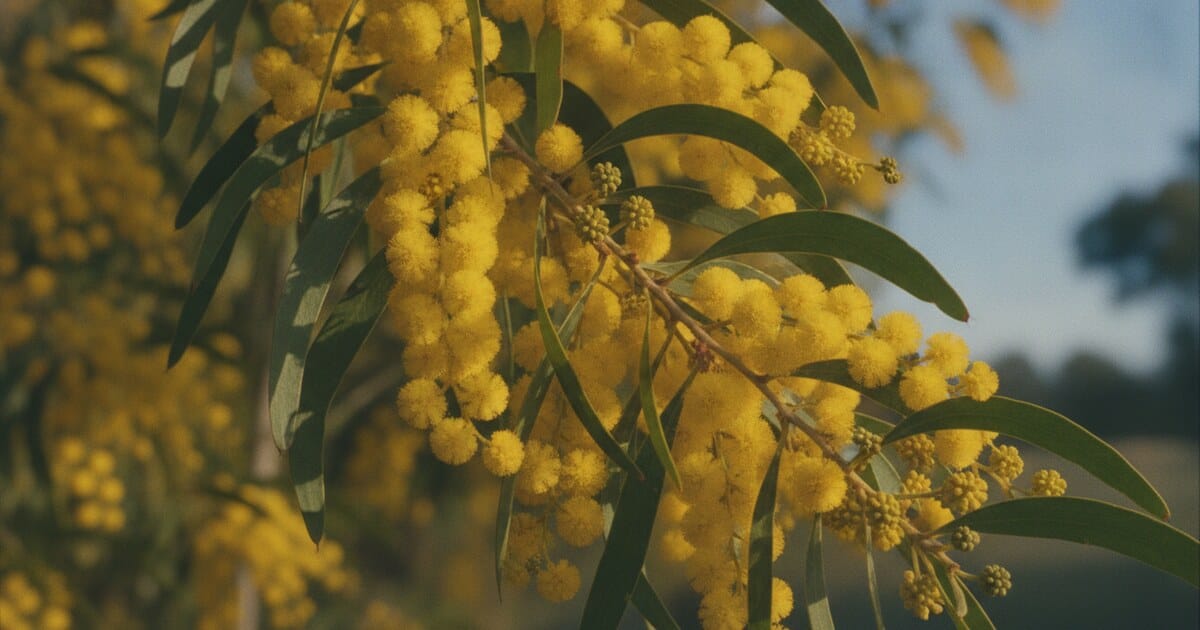
Golden wattle (Acacia pycnantha) is identified by its broad, curved phyllodes (60-200mm long), golden-yellow ball-shaped flower clusters in groups of 6-20 along a raceme, and smooth dark brown to grey bark. It grows as a shrub or small tree reaching 3-8m tall and flowers July to October across southeastern Australia.
What Does Golden Wattle Look Like?
The first thing to understand is that golden wattle doesn’t have true leaves. Like all Australian wattles, it grows phyllodes: flattened leaf stalks that evolved from the petiole rather than the leaf blade itself. In Acacia pycnantha, these phyllodes are broad and sickle-shaped, 60-200mm long and 5-35mm wide, with a single prominent central vein and 1-2 small glands near the base. They’re leathery, hairless, and dark green. That broad profile is why this species is sometimes called “broad-leaved wattle,” a useful shorthand when comparing it to other Australian acacias.
Golden wattle grows as a loosely branched shrub or small tree, 3-8m tall and occasionally reaching 10m in sheltered gullies. The bark is dark brown to grey, smooth on younger stems and finely fissured on older trunks, with the upper trunk often showing a paler, almost whitish bloom. Pods follow the flowers and ripen October to December: flat, brown, 50-130mm long and 5-7mm wide, slightly constricted between each seed. Seeds are black, elliptical (5-6mm long), and shiny, each attached to a folded cream-yellow aril. In southeastern Australia, Acacia pycnantha grows in dry sclerophyll forest, open woodland, and heathland, mostly on red loams or sandy soils below 1,000m elevation. The species tolerates frost to -7°C and colonises disturbed ground readily, which accounts for how far it has spread beyond its native NSW-VIC-ACT range into South Australia, Tasmania, and parts of Western Australia, and why it has become an invasive species in South Africa and parts of the Mediterranean.
The pods and seeds are worth knowing because they let you confirm a golden wattle ID even when the flowers are gone. Many wattle species have similar phyllodes, but the broad, curved profile of A. pycnantha combined with the flat brown pod and cream-yellow aril narrows things down considerably.
Golden Wattle Flowers: When and How to Spot Them
The flowers are what make golden wattle unmistakable. Each individual flower is tiny (1-2mm across), but they’re packed 40-80 per head into dense, spherical clusters about 5-8mm in diameter. Between 6 and 20 of these heads thread along racemes up to 9cm long, producing the arching sprays of gold that cover the whole tree in late winter.
Flowering runs July to October across the native range, with the timing shifting by elevation and latitude. Victorian sites and lowland NSW tend to peak in July-August. Populations in the ACT and higher ranges push into September and October. The flowers are strongly fragrant, a sweet, slightly honeyed scent that carries in warm afternoon air. Native bees and some butterflies work the flowers heavily for pollen.
One practical note: when golden wattle is in full flower, identification is almost trivial. The combination of broad dark-green phyllodes, the raceme structure (multiple globular heads on a single stalk), and the dense fragrant bloom is distinctive enough that you don’t need a field guide. The challenge is off-season identification, which is where the phyllode shape, bark, and pod characters become essential.
How to Tell Golden Wattle From Other Wattles
Australia has more than 1,000 Acacia species, and separating them can be genuinely difficult. A few comparisons make golden wattle easier to pin down.
Silver wattle (Acacia dealbata) is the most common mix-up. Silver wattle has bipinnate leaves: true, fern-like compound leaves with many tiny leaflets arranged in pairs along each stem. The two species sometimes grow in the same woodland, but the leaf type settles the ID immediately. Silver wattle also flowers earlier (May-July) and has a silvery-grey sheen to its foliage. If you see wattle with fern-like leaves, it’s not golden wattle.
Cootamundra wattle (Acacia baileyana) has feathery blue-grey bipinnate leaves and flowers in winter. It’s widely planted as a garden tree across eastern Australia and spreads from seed readily. Again, the bipinnate leaf type puts it in a separate group.
Sallow wattle (Acacia longifolia) also has phyllodes and overlaps with golden wattle in parts of NSW and SA. Its phyllodes are longer and narrower (up to 150mm by 10mm), green, and flat, with 2-3 prominent veins rather than the single dominant central vein of golden wattle. The flower heads of sallow wattle are arranged in cylindrical spikes rather than globular balls.
The simplest rule: golden wattle has broad, curved phyllodes (broader than most wattles) and ball-shaped flower clusters on racemes. If both of those check out, you’re almost certainly looking at Acacia pycnantha. Other golden-flowered wattles are usually shorter-phylloded or have bipinnate leaves.
Where Golden Wattle Grows in Australia
Golden wattle’s native range covers New South Wales, Victoria, and the Australian Capital Territory, mostly on the inland slopes and ranges rather than the coast. You’ll find it in dry sclerophyll forest, open woodland, and heathland, typically on red loams, sandy soils, or rocky ground below 1,000m elevation.
Outside its native range, golden wattle has been widely planted and now spreads naturally across South Australia, Tasmania, and parts of Western Australia. In many of these areas it behaves as a weed along roadsides and in disturbed paddocks, outcompeting native vegetation. Beyond Australia, it’s listed as an invasive species in South Africa (where it causes significant ecological damage in the Cape Floristic Region), Portugal, Spain, and parts of Italy.
In garden settings, golden wattle grows fast: 1-2m per year in reasonable conditions. Most plants in cultivation are relatively short-lived, typically 10-15 years, which is normal for fast-growing wattles. The trade-off is that a young plant can be flowering in its first or second year.
For context on Australia’s other fast-growing native trees from this region, the banksia family and grevillea species share many of the same southeastern Australian habitats as golden wattle and are worth knowing alongside it.
Is Wattle the Same as Mimosa?
Outside Australia, golden wattle is often sold and known as “mimosa.” Botanically, both wattles and mimosas sit within the subfamily Mimosoideae of the family Fabaceae (the pea family), which is where the name comes from. True mimosas (genus Mimosa, native mostly to the Americas and Asia) are distinct from Australian acacias, but European florists have applied the “mimosa” name to any acacia sold as a cut flower, particularly Acacia dealbata and A. pycnantha.
In practice: if you’re in Australia, it’s wattle. If you’re in France, Italy, or Portugal buying spring cut flowers with yellow pom-pom blooms, it’s “mimosa.” It’s the same plant.
The melaleuca (paperbark) and casuarina families cause similar international naming confusion, where the Australian common name diverges sharply from what the plant is called in other parts of the world.
Identifying Golden Wattle With Tree Identifier
When you’re in the field and not sure whether you’re looking at golden wattle or one of the other 1,000-plus Australian wattles, a photo can solve it quickly. Tree Identifier’s AI identifies trees from photos of phyllodes, flowers, bark, and pods, including Australian native species.
The app is available on iOS and Android with 2 free identifications per day. If you’re near a golden wattle in flower, a close-up shot of the flower clusters and phyllodes together gives the clearest result. Off-season, a photo of the phyllodes and a flat pod on the same shot works well. You can also try the free web tool at treeidentifier.app/tools/tree-identifier without downloading anything, which is useful if you’re near a tree and just want a quick answer.
The app works offline once you’ve downloaded species data, which matters if you’re identifying trees in remote bushland without phone coverage.
Frequently Asked Questions
Is golden wattle Australia’s national flower?
Yes. Acacia pycnantha was officially proclaimed Australia’s national floral emblem on August 19, 1988, during the Australian Bicentenary. Wattle Day is celebrated on September 1 each year, marking the start of spring. Australia has more than 1,000 native wattle species, but A. pycnantha was chosen for its wide distribution, profuse golden flowers, and connection to Australia’s green-and-gold national colours.
How do I tell golden wattle from silver wattle?
The leaf type settles it. Golden wattle (Acacia pycnantha) has phyllodes: broad, curved, sickle-shaped modified leaf stalks. Silver wattle (Acacia dealbata) has true bipinnate leaves: fern-like compound leaves with many tiny leaflets. Silver wattle also has a silvery-grey sheen and flowers earlier (May-July vs July-October for golden wattle). Once you see the two types side by side, the difference is obvious.
When does golden wattle flower?
Golden wattle flowers July to October. July-August is the main season across Victoria and lowland NSW, with higher-altitude ACT and range populations peaking in September. The fragrant, golden-yellow ball-shaped flower heads arranged along racemes are the most reliable identification feature when the tree is in bloom. The scent carries on warm afternoons and can alert you to a nearby tree before you spot it.
Is golden wattle native to Western Australia?
Golden wattle’s native range is southeastern Australia: New South Wales, Victoria, and the ACT. It’s been widely introduced to South Australia, Tasmania, and parts of Western Australia, where it grows readily from seed and spreads along roadsides and disturbed ground. It’s not considered native to WA, and in some contexts it’s managed as a weed outside its natural range.
Can you identify golden wattle by its pods and seeds?
Yes, the pods and seeds are reliable off-season markers. Golden wattle pods are flat, brown, and 50-130mm long, slightly constricted between each seed. The seeds are black, elliptical (about 5-6mm long), and attached to a folded cream-yellow aril. That aril is a distinctive wattle feature and helps separate Acacia pods from other legume pods in the bush.
To identify a golden wattle from a photo, snap a close-up of the phyllodes and flower clusters together and run it through Tree Identifier. The app pinpoints the species from leaf shape, flower structure, and bark in seconds. Download it on iOS or Android, or try it free in your browser at treeidentifier.app/tools/tree-identifier.
Identify a tree from your photo — free
Upload a leaf, bark, or whole-tree photo and get the species in seconds. No signup.
Confidence:
Unlock the full species profile
Free in the app — with unlimited identifications.


AI result for guidance — the app gives full species details and works offline.
Want unlimited identifications?
Get the full species profile, photos and details — free in the app, with unlimited scans.
- Unlimited identifications
- Full species profiles & details
- Works offline, anywhere
- Save and revisit your finds
Elena Torres
Tree Identifier Team