Ironbark Tree: Bark, Leaves and Identification Guide
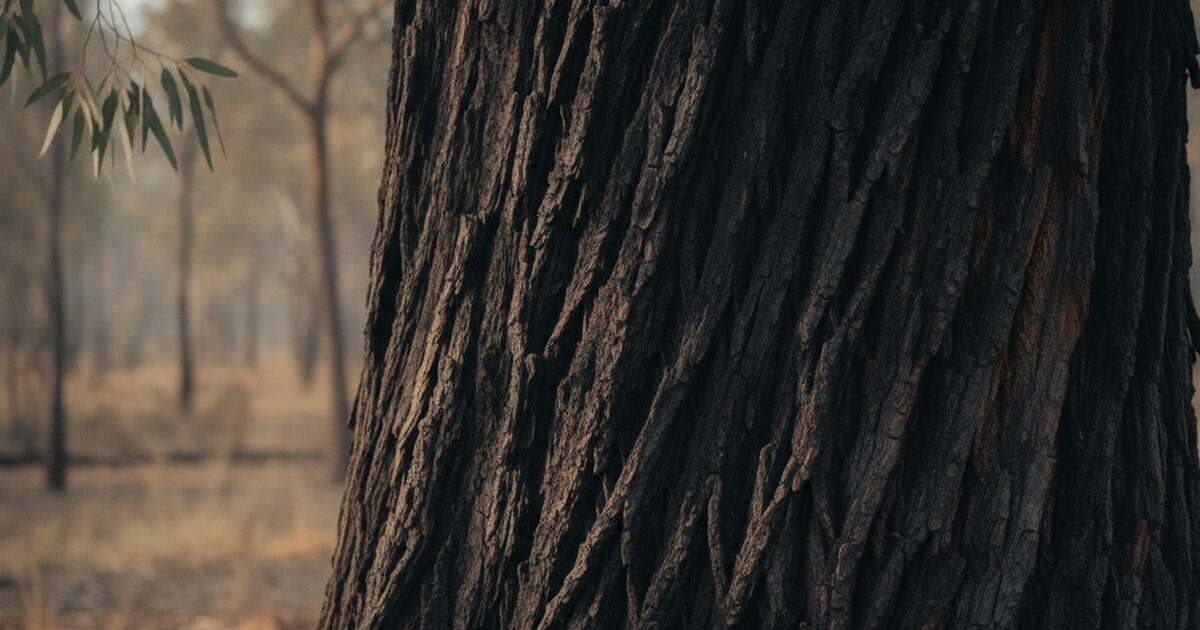
Ironbark trees are some of the most distinctive eucalypts in the Australian bush. When you spot a tree with thick, near-black bark so deeply furrowed it looks carved from stone, and it doesn’t peel, string, or shed, you’re almost certainly looking at an ironbark. This guide covers the three most common species, how to identify them in the field, and what makes their bark so different from every other eucalyptus group.
Ironbark trees are Australian eucalyptus species with hard, permanently rough bark saturated with kino resin. The main species are grey ironbark (Eucalyptus paniculata), red ironbark (Eucalyptus sideroxylon), and narrow-leaved ironbark (Eucalyptus crebra), all growing across eastern Australia. They produce some of the hardest timber in the country and are significant food sources for nectar-feeding birds.
What Makes Ironbark Bark Different
Most eucalypts shed their outer bark at some point. Smooth gums like the spotted gum peel in curved patches, leaving a mottled white and grey surface. Stringybarks produce loose, fibrous layers that pull away in long strips. Ironbark does neither.
The ironbark’s bark is saturated with kino, a dark red resin secreted by the cambium as the tree grows. The kino soaks through the outer bark cells, hardening them into dense, rigid ridges. It also stains the bark a deep brown to near-black. Over decades, the ridges and furrows deepen without the outer layers ever falling off.
Press a thumbnail firmly into an ironbark and it barely marks. Knock the trunk with a knuckle and it rings harder than most timbers. These two quick tests are worth remembering.
Ironbark trees form a distinct group within Eucalyptus defined by permanently hard, non-shedding bark impregnated with dark kino resin. When the cambium produces kino, the resin fills the outer bark cells and hardens over time, building the dense ridged texture that gives ironbarks their name and their extraordinary timber strength. Grey ironbark (Eucalyptus paniculata) and red ironbark (Eucalyptus sideroxylon) are the two most commercially significant species, both producing timber with a Janka hardness of around 14,000 newtons, among the hardest woods in Australia. Red ironbark timber weighs approximately 1,120 kg/m³ air dry, roughly twice the density of radiata pine. Historically, ironbark was the primary timber for Australian railway sleepers, bridge construction, and wharf piles from the 1860s through the 20th century. Aboriginal Australians harvested ironbark bark for canoes, water carriers, and shelters, and used the kino resin for its astringent medicinal properties.
Ironbark Species: Grey, Red and Narrow-Leaved
Around a dozen eucalyptus species carry the ironbark name, but three are most widespread across eastern Australia.
Grey Ironbark (Eucalyptus paniculata)
Grey ironbark is the tallest of the group, reaching 20-35m in good conditions. It grows along the coast and ranges of New South Wales and into southern Queensland, typically on shallow, rocky soils alongside Sydney blue gum and scribbly gum.
The bark is dark grey to near-black, with deep vertical furrows extending from the base to the smallest branches. Leaves are lance-shaped, 8-15 cm long, and grey-green on both surfaces. Flowers are small white clusters that appear in autumn and winter, drawing yellow-faced honeyeaters and eastern spinebills in numbers. The flower buds are club-shaped with a slightly flattened cap.
Red Ironbark (Eucalyptus sideroxylon)
Red ironbark grows 10-25m tall and is found further inland, across central and western New South Wales and into Victoria. Its bark texture is the same as grey ironbark but tends toward reddish-brown rather than black-grey.
The most reliable identification feature is the flowers. Red ironbark produces pink to deep crimson blooms from autumn through winter, unlike any other ironbark. The buds are diamond-shaped and angular, a useful feature when flowers aren’t present. The foliage has a slightly weeping habit that becomes more obvious on younger trees.
Narrow-Leaved Ironbark (Eucalyptus crebra)
Narrow-leaved ironbark is Queensland’s most widespread ironbark and a common sight in dry sclerophyll woodland across the state, extending into northern New South Wales. It grows 8-20m tall.
The leaves are noticeably narrower than the other two species: 7-12 cm long and often a slightly yellowish-green rather than pure grey-green. Flowers are white, appearing in spring. Bark is dark grey to black. In mixed eucalyptus woodland across Queensland’s interior, it’s often the dominant ironbark species.
Telling Ironbark from Other Rough-Barked Eucalypts
Several eucalyptus groups have rough bark, and separating them in the field takes practice. Three comparisons come up most often.
Ironbark vs Stringybark
Stringybark bark is soft and fibrous, pulling away in long strings if you tug it. Ironbark bark is hard and dense. If you can pull strips of loose material away with your fingers, it’s stringybark.
Ironbark vs Box Eucalypts
Box eucalypts have hard, finely furrowed bark on the lower trunk, but the upper branches go smooth or ribbony where the bark sheds. Ironbark keeps its rough, hard bark all the way to the smaller branches. Follow the bark up: if the upper canopy is smooth, it’s a box, not an ironbark.
Ironbark vs Peppermint
Peppermints have a finely fibrous bark that looks similar to ironbark at a distance. Crush a leaf: peppermints have a strong menthol scent, while ironbark leaves are unscented or faintly astringent. The lemon-scented gum uses the same scent test principle — its citronellal fragrance makes it impossible to confuse with any ironbark on smell alone.
Ironbark Timber and Wildlife Value
Timber
Ironbark produces some of the hardest timber in Australia. Grey ironbark has a Janka hardness of around 14,000 N, well above jarrah (8,900 N) and blackwood (6,000 N). Both grey and red ironbark are durability class 1, meaning untreated timber lasts more than 25 years in ground contact.
From the 1860s onward, ironbark was the material of choice for Australian railways, bridges, and wharves. Victorian and New South Wales rail networks ran on ironbark sleepers for decades. The timber is still used today in heavy construction, marine engineering, decking, and structural flooring wherever hardness and long-term durability matter.
Wildlife
The winter flowers of red ironbark are a significant resource for nectar-feeding birds during the months when few other flowering trees are available. Musk lorikeets, purple-crowned lorikeets, and several honeyeater species rely on them heavily. Ironbark flowers, alongside those of banksias and grevilleas, form a key part of eastern Australia’s winter nectar supply.
Older ironbark trees develop hollows in dead branches and the main trunk, providing nesting sites for rosellas, owls, sugar gliders, and possums. A large, hollow-bearing ironbark is a habitat tree worth noting on any property.
Identifying Ironbark Trees with Tree Identifier
If you’re in the bush with a rough-barked eucalyptus and need a confident species identification, Tree Identifier can help. The app recognizes ironbark species from photos of bark, leaves, or flowers, and it handles the separation between ironbark, box, and stringybark groups that trips up most field guides.
Take a close-up of the bark texture, then a second photo of a leaf against a plain background. For red ironbark, a flower photo in season is the most decisive shot. The app returns a species name with a confidence score, plus habitat and characteristics detail for that species.
Tree Identifier works offline, which matters in the dry woodland and ranges country where ironbarks are most common. Download the species data before heading out and it runs without a mobile signal. The app is free to start, with 2 identifications per day on iOS and Android.
You can also scan a tree at treeidentifier.app/tools/tree-identifier without downloading anything for a quick browser-based ID.
Frequently Asked Questions
Is ironbark a hardwood?
Yes. Ironbark is one of the hardest hardwoods in Australia. Grey ironbark has a Janka hardness of around 14,000 newtons, placing it well above most Australian and European timbers, including jarrah, blackwood, and red cedar.
What is red ironbark used for?
Red ironbark timber is used in heavy construction, bridge building, wharf piles, railway sleepers, decking, and flooring. Its durability class 1 rating means untreated timber lasts more than 25 years in ground contact, making it suitable for structural and outdoor applications.
How do I tell ironbark from stringybark?
Press a fingernail firmly into the bark. Stringybark is soft and fibrous, pulling away in strips. Ironbark is hard and dense, barely marking under pressure. If the bark strings or peels off, it’s not ironbark.
Why is it called ironbark?
The name comes from the bark’s iron-hard texture. As the tree grows, the cambium secretes kino resin that soaks into the outer bark cells and hardens them over time. The result is thick, rigid ridges noticeably harder than the bark on any other eucalyptus group.
What birds do ironbark trees attract?
Red ironbark’s pink-red winter flowers attract musk lorikeets, purple-crowned lorikeets, and several honeyeater species. Grey ironbark’s white autumn flowers are used heavily by yellow-faced honeyeaters and eastern spinebills. Older trees with hollows provide nesting sites for rosellas, owls, and gliders.
Next time you’re in eastern Australian bush, download Tree Identifier and photograph any bark, leaf, or flower you’re unsure about. The app covers hundreds of Australian native tree species, including all three common ironbarks, with instant identification and detailed species information.
Identify a tree from your photo — free
Upload a leaf, bark, or whole-tree photo and get the species in seconds. No signup.
Confidence:
Unlock the full species profile
Free in the app — with unlimited identifications.


AI result for guidance — the app gives full species details and works offline.
Want unlimited identifications?
Get the full species profile, photos and details — free in the app, with unlimited scans.
- Unlimited identifications
- Full species profiles & details
- Works offline, anywhere
- Save and revisit your finds
Elena Torres
Tree Identifier Team