Stringybark Tree: Bark, Leaves and Identification Guide
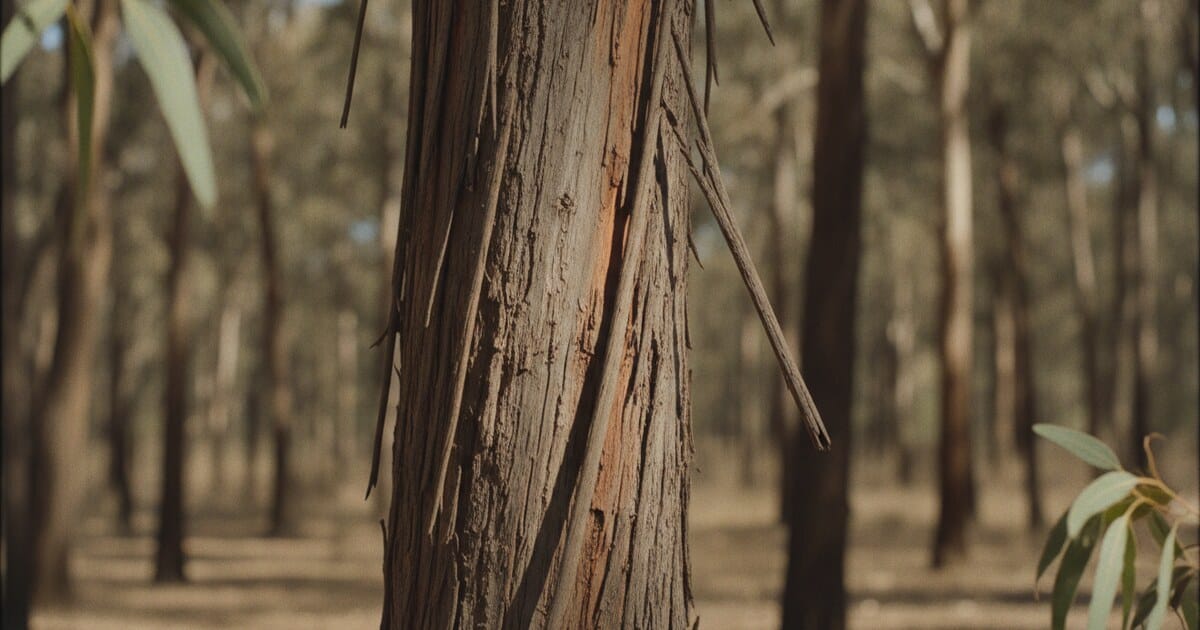
Walk through dry Australian woodland and you’ll often come across trees with bark that doesn’t behave like bark. Long fibrous strips hang from the trunk in vertical ribbons, pulling away without completely detaching. Those are stringybarks: a group of eucalypts named for that loose, fraying outer layer that wraps mature trunks like shredded rope. Australia has more than 50 species carrying this character, spread from Tasmania’s wet mountain forests to the Top End’s seasonally dry woodlands. Despite looking broadly similar from a distance, stringybark species vary in height, leaf shape, timber quality, and habitat. This guide covers the key identification features, the most common species, and how to separate stringybark from the other rough-barked eucalypts sharing the same bush.
Stringybark trees are eucalypts identified by their fibrous outer bark, which hangs in long vertical strips and doesn’t shed cleanly from the trunk. Common species include Red Stringybark (Eucalyptus macrorhyncha), Yellow Stringybark (E. muelleriana), Messmate Stringybark (E. obliqua), and Darwin Stringybark (E. tetrodonta). All produce hard, dense timber valued for construction and firewood.
The Bark That Names Them
The defining feature of a stringybark isn’t color or texture in the usual sense. It’s behavior. Grip a strip of the outer bark between your fingers and pull. The fibrous material stretches and strings rather than breaking cleanly. That character separates stringybarks from every other rough-barked eucalypt in the bush.
Structurally, the bark builds up in thick layers on the main trunk and largest branches. On older specimens it commonly reaches 50-100 mm deep, and the outermost dead bark hangs in vertical ribbons that gradually detach from below. Run your hand up an old trunk and the loose ends catch on your fingers. The inner face of each strip is usually smooth and off-white or pinkish, contrasting with the grey-brown of the weathered exterior.
Stringybarks (genus Eucalyptus, subgenus Eucalyptus) are among Australia’s most fire-adapted trees. The fibrous outer bark, which can exceed 100 mm on mature trunks, insulates the cambium layer during low-intensity ground fires, letting the tree survive heat that would kill thin-barked species. The bark builds up from hundreds of overlapping layers of dead cells compacted over decades. In higher-intensity fires the outer layers char and can smoulder, but the cambium underneath frequently survives intact. Most stringybark species also carry a lignotuber: a woody swelling at the base that stores carbohydrate reserves and drives coppice regrowth after crown loss. Eucalyptus obliqua, the Messmate Stringybark, was the first eucalypt formally described by Western science when French botanist L’Héritier de Brutelle published the species in 1788 from specimens collected in Tasmania. The Messmate is also Australia’s tallest stringybark, documented to 90 metres in sheltered mountain gullies in Tasmania and Victoria.
The bark color varies from grey-brown on the weathered surface to reddish or orange-brown where fresh strips have recently separated. Red Stringybark (E. macrorhyncha) shows a distinctly reddish hue in the lower trunk that gives the species its name.
Common Stringybark Species in Australia
Australia’s stringybarks are concentrated in the southeast and east, with one significant outlier in the far north.
Messmate Stringybark (Eucalyptus obliqua) is the most widespread and the tallest. It grows from Tasmania through Victoria and NSW into southern Queensland, reaching 90 metres in sheltered mountain gullies. The species name “obliqua” refers to the asymmetrical base of its adult leaves. Mature trees build up deeply fibrous bark that strips away in long coarse handfuls.
Yellow Stringybark (Eucalyptus muelleriana) is the main commercial timber species of the group. It occupies coastal and subcoastal ranges of NSW and eastern Victoria at altitudes of 300-900 metres. Yellow Stringybark grows smaller than Messmate, typically 20-40 metres, but its timber is denser and more consistently yellow-brown.
Red Stringybark (Eucalyptus macrorhyncha) covers the southern tablelands of NSW through to central Victoria. It’s a medium-sized tree (15-30 metres) most often found on dry, poorer soils at 300-800 metres. The reddish lower trunk bark distinguishes it from Yellow Stringybark, which runs grey-brown.
Thin-leaved Stringybark (Eucalyptus eugenioides) grows along the coast and coastal ranges of NSW and southeastern Queensland, typically at lower altitudes than other stringybarks. It’s smaller, usually 10-25 metres, with thinner adult leaves than Messmate.
Darwin Stringybark (Eucalyptus tetrodonta) is the outlier. It grows across the monsoonal woodlands of the Northern Territory and the Kimberley, reaching 9-18 metres. Cyclone-tolerant and drought-hardy, it’s one of the dominant woodland trees across tropical northern Australia.
Stringybark Leaves, Flowers and Fruit
Adult leaves across the group are broadly lanceolate to ovate-lanceolate, typically 10-20 cm long with a slightly glossy upper surface. The most useful leaf character is the base: in many species, including Messmate, the leaf base is oblique or asymmetrical, where one side attaches to the petiole slightly higher than the other. That asymmetry is subtle but consistent.
Juvenile leaves differ noticeably from adult leaves: broader, rounder at the base, and often stalkless (sessile), clasping the stem. Coppice regrowth after fire or cutting produces these juvenile leaves, so a regrowth stem looks quite different from the adult canopy above. The same species can produce two very different leaf shapes at different stages of growth.
Flowers are small and white to cream, appearing in clusters of 7 buds at branch tips and in leaf axils. They open progressively from October through February depending on species and latitude. Honeyeaters and swift parrots are among the primary pollinators, and the flowering period is brief but important for native fauna. Fruit capsules are small (0.4-0.8 cm), cup-shaped to hemispherical, with 3-4 enclosed valves. They persist on the tree for months after seeds drop.
Bud clusters in most stringybark species sit on a flattened or angular peduncle (stalk). The bud cap (operculum) is usually shorter than the hypanthium, giving each bud a slightly squat appearance compared to the elongated caps on peppermint species. That bud shape is a useful secondary character when you can’t reach a bark sample.
Stringybark Timber and Firewood
Stringybark species are hardwoods. The bark is fibrous and soft to the touch, but the timber inside is dense, interlocked-grain hardwood.
Yellow Stringybark (E. muelleriana) has a Janka hardness rating of approximately 8,900 N, comparable to tallowwood and spotted gum. Red Stringybark (E. macrorhyncha) runs slightly softer at around 6,900 N. Both figures sit well above softwoods like radiata pine, which typically rates 1,500-2,700 N.
Yellow Stringybark’s commercial uses include:
- Flooring (the pale yellow-brown color suits both traditional and modern interiors)
- Structural beams, rafters, and purlins
- Bridge decking and wharves (naturally durable, rated Class 1-2 for in-ground contact)
- Railway sleepers (historically its primary industrial use in eastern NSW)
- Poles and posts
Red Stringybark is highly regarded as firewood. Its density converts directly into heat output. Well-dried Red Stringybark logs produce around 18-20 GJ per tonne, placing them alongside ironbark and river red gum in the top tier of Australian firewood species.
Messmate (E. obliqua) and Thin-leaved Stringybark (E. eugenioides) also carry strong timber properties but are less consistent than Yellow or Red Stringybark. Messmate is widely used in structural applications in Victoria and Tasmania where it grows at commercial scale.
Stringybark vs Similar Trees
Several eucalypts share the rough-barked woodland habitat with stringybarks, but the bark characters are actually quite distinct once you’ve handled them.
Stringybark vs. ironbark: Ironbark is the clearest comparison. Ironbark bark is hard, deeply furrowed, and dark grey to near-black, saturated with dried kino resin. Press a thumbnail into ironbark and it’s like pressing into stone. Press a thumbnail into stringybark and the fibrous outer layer compresses and shifts. The two bark types are unmistakably different once you’ve felt both.
Stringybark vs. box eucalypts: Box bark is also rough and fibrous but has shorter, more interlocked fibres that don’t pull away in long strips. Box bark breaks more cleanly than it strings, and feels harder under the palm. The bark layers on box eucalypts are also thinner than the deep stringybark build-up on old trunks.
Stringybark vs. peppermint eucalypts: Peppermint bark looks similar from a few metres away, but crushed leaves separate them in under a second. Peppermints release a sharp, clean peppermint oil scent noticeably stronger than general eucalyptol. Peppermint bark fibres are also finer than the coarse stringybark strips.
Stringybark vs. spotted gum: Spotted gum (Corymbia maculata) sheds bark in patches, leaving a mottled grey, cream, and tan surface that couldn’t look less like fibrous stringybark. Smooth and patterned versus fibrous and hanging: the two are impossible to confuse in the field.
How Tree Identifier Helps You Spot a Stringybark
Stringybark identification can get tricky when you’re looking at a young tree where the bark hasn’t developed its full fibrous character yet, or when you’re trying to separate species rather than just confirm the group.
Tree Identifier reads photos of bark, leaves, and branch tips to return a species-level ID with a confidence score. For the best results, photograph the bark at mid-trunk height (showing the fibrous strip texture), a mid-canopy branch with adult leaves visible, and a close-up showing the leaf base shape. Those 3 angles give the app enough data to separate E. obliqua from E. macrorhyncha from E. muelleriana, which share habitat across the NSW tablelands and central highlands.
Open Tree Identifier on iOS or Android and photograph the bark. The app works offline after downloading the species data, which matters on remote bushwalks away from cell coverage. Start free with 2 identifications per day, or try the web-based tree identifier in your browser without installing anything.
For a broader look at Australian native trees, the banksia guide links through to the full library of species ID articles in this series.
Frequently Asked Questions
Is stringybark a hardwood or softwood? Stringybark species are hardwoods. The fibrous outer bark is soft to the touch, but the timber is dense interlocked-grain hardwood with Janka ratings of 6,900-8,900 N depending on species. Yellow Stringybark (E. muelleriana) sits at approximately 8,900 N, comparable to spotted gum and tallowwood. Softwoods like radiata pine typically rate 1,500-2,700 N.
What is stringybark bark used for traditionally? Indigenous Australians have long used stringybark for bark canoes, shelters (lean-tos called mia-mias), and carrying containers. The Worimi people of coastal NSW shaped fire-softened strips into canoes called Kuueeyung, using crystallized tree sap to waterproof the seams. The bark’s strength-to-weight ratio made it useful for temporary structures built and left as people moved through country.
Are all stringybark trees eucalypts? Yes. All stringybark species belong to the genus Eucalyptus, family Myrtaceae. The “stringybark” name describes a bark type found across multiple unrelated species groups within the genus rather than a single closely related clade. Darwin Stringybark (E. tetrodonta) is only distantly related to Messmate (E. obliqua) despite sharing the same common name.
How do you tell stringybark from ironbark in the field? Press your palm firmly against the trunk and try to pull a strip. Stringybark outer bark pulls away in long fibrous strips with minimal force. Ironbark bark is resin-hardened, deeply grooved, and doesn’t yield at all. The color also separates them: ironbark runs dark grey to near-black, while stringybark is typically mid-grey to reddish-brown.
Stringybarks are some of the most common trees across eastern Australia’s woodland and forest country, and knowing how to identify them opens up a useful framework for reading the whole eucalypt landscape. Once you know what the fibrous bark feels like and what the oblique leaf base looks like, the group clicks into place quickly.
If you’re trying to pin down the exact species, photograph the bark and leaves and run them through Tree Identifier: available on iOS and Android, free to start with 2 daily identifications.
Identify a tree from your photo — free
Upload a leaf, bark, or whole-tree photo and get the species in seconds. No signup.
Confidence:
Unlock the full species profile
Free in the app — with unlimited identifications.


AI result for guidance — the app gives full species details and works offline.
Want unlimited identifications?
Get the full species profile, photos and details — free in the app, with unlimited scans.
- Unlimited identifications
- Full species profiles & details
- Works offline, anywhere
- Save and revisit your finds

Elena Torres
Tree Identifier Team