Silky Oak Tree: Bark, Leaves and Identification Guide
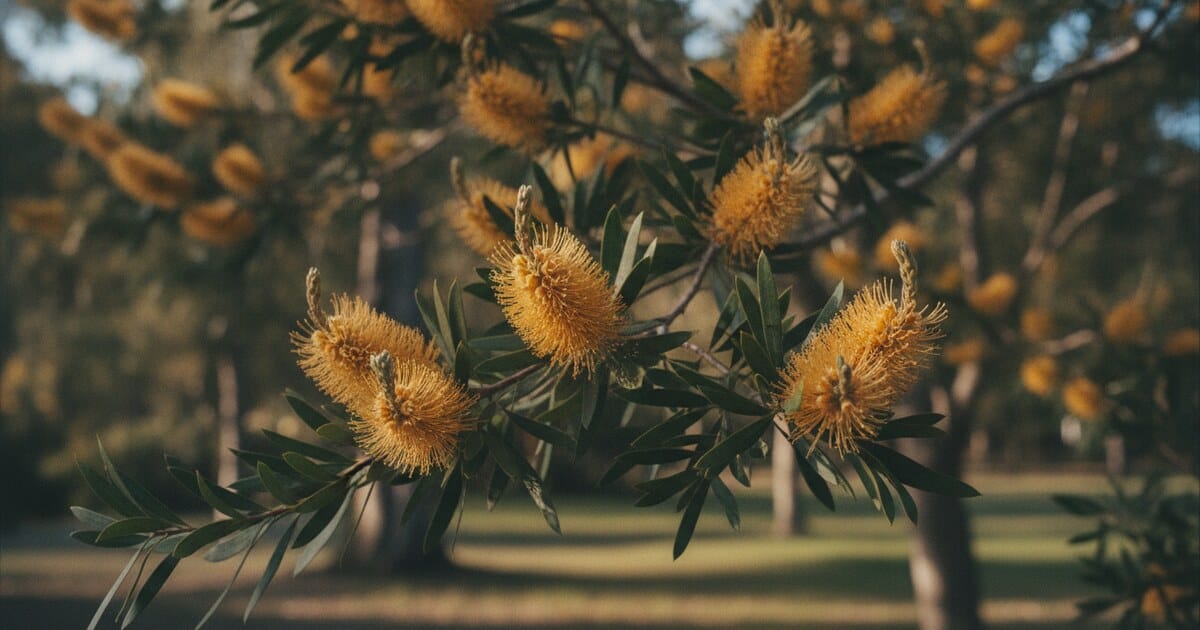
Walk past a silky oak in full bloom and you’ll pause mid-stride. The tree erupts into cascades of golden-orange brush clusters every spring, each one dripping with nectar that pulls honeyeaters and lorikeets from every corner of the garden. It’s one of Australia’s most dramatic native trees, and people are often surprised to learn it has nothing to do with oak trees.
Silky oak (Grevillea robusta) is a member of the Proteaceae family, the same botanical group as banksias and grevilleas. The name comes from the timber: quarter-sawn planks reveal a silvery, ray-flecked grain that early colonial craftsmen compared to English oak, and the name stuck. This guide covers everything you need to identify one in the field: the fern-like leaves, bark changes through age, the flowers, the seed pods, and the size you can expect.
Silky oak (Grevillea robusta) is a fast-growing Australian native with fern-like bipinnate leaves up to 30 cm long and golden-orange brush flower clusters in spring. Despite the name, it belongs to the Proteaceae family. In its native Queensland habitat it reaches 35 metres; in cultivation it typically grows 9 to 12 metres tall.
What Is Silky Oak?
Grevillea robusta is the largest species in the Grevillea genus, which contains over 350 species native to Australia. It grows naturally along the coastal ranges of southeast Queensland and northeast New South Wales, in subtropical and tropical dry forests near rivers and creek lines.
The “silky oak” name is a timber trade label from the colonial era. When the wood is quarter-sawn, the medullary rays running through it catch the light and create a flecked, silky shimmer that reminded early carpenters of English oak. The tree ended up with a name borrowed from a species on the other side of the planet.
Grevillea robusta, the silky oak, belongs to the family Proteaceae, which evolved on the ancient supercontinent Gondwana alongside banksias, macadamias, and proteas. It’s native to the subtropical and tropical dry forests of southeast Queensland and northeast New South Wales, and it’s the largest species in the Grevillea genus, which has over 350 species. In natural stands it grows to 35 metres and can spread up to 10 metres across.
The common name “silky oak” comes from the timber: quarter-sawn planks expose medullary rays that create a flecked, silky shimmer similar to English oak. The wood was widely used in early 20th-century Australian furniture, cabinetry, and kitchen joinery, and it still trades as “lacewood” in the antique furniture market today. The species was later introduced to Hawaii, South Africa, California, and Mediterranean countries as an ornamental tree, where it now grows well beyond its original Australian range.
Despite the shared name, silky oak is far more closely related to banksias and waratahs than to anything in the oak family. The flowers make this obvious: silky oak produces long brush clusters of nectar-rich tubes, not the catkins and acorns you’d find on a true oak (Quercus spp.).
Compare the leaf shapes side by side and the difference becomes unmistakable. An oak leaf has rounded or pointed lobes on a single blade. A silky oak leaf is bipinnately divided into dozens of small segments, looking more like a fern frond than any oak you’d find in Europe or North America.
How to Identify Silky Oak: Leaves, Bark, and Flowers
Three features make silky oak unmistakable in the field: the fern-like leaves with their silvery undersides, the bright spring flower spikes, and the deep bark furrows on older trees.
Leaves
The leaves are 15 to 30 cm long and bipinnately divided, which means each leaf is carved into smaller segments arranged like the fronds of a tree fern. The upper surface is dark green and smooth. Flip one over and you’ll find the underside covered in fine silky hairs, giving it a silver-grey sheen. That silvery underside is the fastest ID marker in the field, usable even when the tree has no flowers.
Flowers
Silky oak flowers in spring, producing golden-orange to yellow brush clusters (racemes) 7 to 12 cm long along the branches. Each individual flower is a curved tube with the style protruding from the end, a shape that’s characteristic across the Grevillea genus. The clusters produce abundant nectar and are a reliable food source for honeyeaters, lorikeets, and native bees. A mature tree in full flower can look almost entirely gold from a distance.
Bark
Young silky oaks have smooth, grey bark. As the tree ages, the trunk darkens and deep longitudinal furrows get carved into the surface, with interlocking ridges running up and down the trunk. This furrowed grey bark is useful for identification in winter when there are no flowers or leaves to check.
The smaller branches keep a slight silvery, hairy surface throughout the tree’s life.
Fruit and Seeds
After flowering, silky oak produces small dark brown pods roughly 2 cm long. Each pod is slightly curved and dehiscent: it splits open when ripe to release one or two flat, winged seeds. The wings carry seeds on air currents, which is why silky oak seedlings often pop up in garden beds and lawns well away from the parent tree.
Silky Oak Growth Rate and Size
Silky oak is one of Australia’s fastest-growing trees. In good garden conditions it can add 2 to 3 metres in height per year when young. By the time a tree is 10 years old, expect it to stand 8 to 12 metres tall, though soil quality and rainfall push that number up or down considerably.
Garden-grown trees typically reach 9 to 12 metres at maturity, with a spread of 5 to 8 metres. In its native subtropical forests along Queensland’s coastal ranges, the species climbs to 35 metres. The size difference comes down to competition: forest trees reach upward for light in ways a garden tree with open space doesn’t need to.
That growth speed has a trade-off. Silky oak wood is brittle, and established trees are prone to branch drop in strong winds or storms. Planting at least 5 metres from structures, fences, and power lines is the right call before the tree reaches any size.
Silky oak behaves differently depending on the climate. In tropical regions it stays evergreen year-round. In cooler subtropical and warm temperate areas, it tends to drop most of its leaves in spring, just before or during flowering. This surprises gardeners expecting a full canopy when the golden flowers arrive. The bare branches carrying clusters of orange-gold brush spikes are actually the tree looking its most dramatic.
Silky Oak Timber: The Lacewood Connection
The reason an Australian Proteaceae ended up carrying the name of an English hardwood comes down entirely to woodgrain.
When silky oak timber is quarter-sawn, the medullary rays running through the wood become visible as broad, satiny flecks. The effect closely resembles the ray figure in true oaks, and colonial carpenters working with unfamiliar local timbers reached for the nearest name they already knew.
Australian silky oak was a staple of early 20th-century furniture making. Kitchen cabinets, wardrobes, sideboards, and interior joinery were commonly built from it across Queensland and New South Wales. Today, antique dealers often sell this furniture under the label “Australian lacewood” to distinguish it from other figured timbers with a similar look.
The wood has medium density and cuts cleanly with both hand and power tools. It’s still used for furniture, cabinetry, veneers, and wood turning.
Silky oak timber can cause contact dermatitis in sensitive individuals. The sawdust and fresh wood both contain compounds that trigger skin irritation, eye discomfort, and respiratory reactions. Gloves and a dust mask are worth wearing when cutting or sanding it.
Identifying Silky Oak With Tree Identifier
If you spot a silky oak in a park, garden, or bushland area and want to confirm the identification, a photo is all you need. The Tree Identifier app takes a shot of the leaves, flowers, or bark and returns the species name, confidence score, and detailed information about the tree.
The app picks up silky oak particularly well from leaf photos. The fern-like bipinnate shape is highly distinctive, and the silvery underside adds a second confirming feature that the AI recognises reliably. Flower clusters in spring are even cleaner to identify: the golden-orange brush shape is characteristic enough that one clear photo almost always does it. For bark on a mature tree, a close-up of the furrowed ridge pattern gives the AI enough texture to work from.
Tree Identifier works offline, so you can use it on bushland walks without mobile signal. It covers thousands of Australian native species alongside trees from around the world, and it includes 2 free identifications per day. You can also try the web-based identification tool at treeidentifier.app/tools/tree-identifier directly in your browser without downloading anything.
To explore more Australian Proteaceae relatives, the grevillea guide covers the broader genus, and the banksia identification guide is the starting point for Australian flowering natives on this blog.
Frequently Asked Questions
Is silky oak a real oak tree?
Silky oak (Grevillea robusta) belongs to the family Proteaceae, which groups it with banksias, macadamias, and waratahs rather than true oaks. True oaks belong to the genus Quercus in the family Fagaceae. The “silky oak” name comes purely from the timber’s silvery, oak-like grain when quarter-sawn, not from any botanical relationship between the two trees.
How fast does silky oak grow?
Silky oak is one of Australia’s fastest-growing native trees, adding up to 2 to 3 metres per year in good conditions. A 10-year-old garden tree typically stands 8 to 12 metres tall. In its native Queensland subtropical forests, the species reaches up to 35 metres.
Can silky oak cause allergies?
Some people develop contact dermatitis from handling silky oak timber or fresh wood. The sawdust can also cause skin irritation, eye discomfort, and respiratory reactions in sensitive individuals. Gardeners and woodworkers handling the timber should wash their hands after contact, and woodworkers should wear gloves and a dust mask when cutting or sanding.
Do silky oaks have invasive roots?
Silky oak roots can spread aggressively in garden settings, particularly when they sense water near irrigation lines and pipes. The tree’s fast growth means root systems establish quickly and cover a wide area. Plant at least 5 metres from foundations, pipes, and established garden beds. In some regions outside Australia, including Hawaii and South Africa, silky oak has naturalised well beyond original garden plantings.
If you’re trying to identify a silky oak in the field, try the Tree Identifier app. Snap a photo of the fern-like leaves or a spring flower cluster and get a confirmed identification in seconds. The app works offline for remote bushland hikes and covers thousands of Australian native species. Download it at treeidentifier.app or use the free web tool without signing up.
Identify a tree from your photo — free
Upload a leaf, bark, or whole-tree photo and get the species in seconds. No signup.
Confidence:
Unlock the full species profile
Free in the app — with unlimited identifications.


AI result for guidance — the app gives full species details and works offline.
Want unlimited identifications?
Get the full species profile, photos and details — free in the app, with unlimited scans.
- Unlimited identifications
- Full species profiles & details
- Works offline, anywhere
- Save and revisit your finds

Elena Torres
Tree Identifier Team