Black Wattle: Leaves, Bark, Flowers and ID Guide
The name black wattle refers to the dark, deeply furrowed bark that develops on mature trunks, not the leaves or flowers. Young trees have smooth, grey-green bark that can cause confusion in the field. Add the feathery bipinnate leaves and clouds of cream-yellow flowers in spring, and you have one of southeastern Australia’s most recognizable natives. Acacia mearnsii grows fast, lives briefly (15 to 30 years for most individuals), and fixes nitrogen into the soil throughout its life. It’s also one of the few Australian natives to become a significant invasive tree on multiple continents.
Black wattle (Acacia mearnsii) is a fast-growing Australian native reaching 6 to 15 meters tall. Key ID features: bipinnate feathery leaves with 7 to 31 pairs of pinnae, raised glands at and between pinnae junctions, creamy-yellow fragrant flower heads from October to December, and dark constricted pods. Bark turns grey-black on mature trunks. All parts are finely hairy.
What Does Black Wattle Look Like?
Black wattle grows as a round, spreading tree with a dense dark green canopy. Typical height is 6 to 15 meters, though specimens on rich river flats occasionally reach 20 to 25 meters. Young trees often have multiple stems rising from the base.
Bark is what earns the common name. On saplings and young trees it’s smooth and grey-green, sometimes flushed reddish-brown on sun-exposed stems. As the tree ages, bark darkens gradually through grey to near-black at the base of older trunks.
Mature bark develops deep ridges and fissures, especially toward the base. When cut or damaged, the bark splits to release a dark, sticky resin. That resin stain on the trunk is a useful field marker alongside the visual darkening.
The species is native across southeastern Australia: its core range covers ACT, New South Wales, Victoria, and Tasmania, with smaller populations in Queensland, South Australia, and Western Australia. It grows on river banks, gully edges, disturbed forest margins, swampy flats, and open woodland. It tolerates gravelly clay, black peaty soil, brown sandy clay, and heavy soils alike, across cool temperate to Mediterranean climate zones.
Acacia mearnsii is one of the world’s most commercially significant wattles, largely because its bark holds 30 to 45 percent tannin by dry weight. South Africa imported the species in 1871 to supply the leather tanning industry. It eventually escaped plantations and became one of that country’s most widespread invasive trees. The species is now naturalized in New Zealand, Hawaii, Kenya, India, Portugal, and across parts of the Mediterranean basin. Seeds can remain dormant in soil for up to 90 years, making control extremely difficult after initial removal. In its native southeastern Australian range, the picture is different. Black wattle fixes atmospheric nitrogen through root nodule bacteria, restores degraded soils on disturbed land, and supports pollen-feeding birds, insects, and the rare Tasmanian Hairstreak butterfly, which deposits eggs in bark crevices. Growth is fast (typically 1 to 2 meters per year in good conditions) but lifespans are short, commonly 15 to 30 years.
Black Wattle Leaves: The Bipinnate Difference
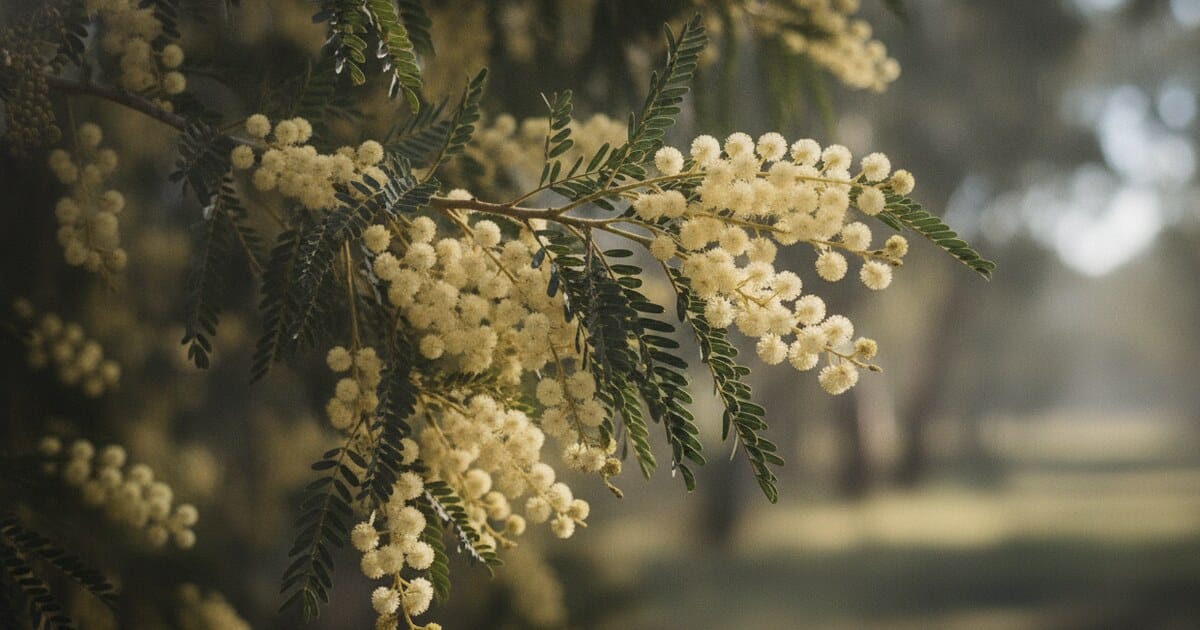
The leaves are where black wattle ID gets precise. Black wattle has bipinnate leaves: each leaf stalk carries multiple branches (pinnae), and each branch carries pairs of tiny leaflets (pinnules). The leaf axis runs 30 to 135 mm long with 7 to 31 pairs of pinnae, and each pinna carries 25 to 78 pairs of pinnules measuring just 1 to 4 mm long by 0.5 to 0.8 mm wide. The result is a finely textured, feathery appearance quite distinct from the broader-leaved or phyllode-bearing wattles.
All plant parts are finely hairy. Young growth is covered in dense, velvety pale hairs and appears yellow-green before maturing to dark olive-green. The whole tree has a soft, matte texture compared to the shinier foliage of some related species.
The gland pattern on the leaf axis is the most reliable test for separating black wattle from silver wattle (Acacia dealbata). Black wattle has raised, dark glands at the junctions between pinnae pairs and at points between them (interjugary glands). Silver wattle only has glands at the junctions, not between them.
Run your finger along the leaf axis and feel for the small raised bumps. Extra glands between the pinna junctions confirm black wattle.
This bipinnate structure also separates black wattle from golden wattle (Acacia pycnantha), Sydney golden wattle (Acacia longifolia), and blackwood (Acacia melanoxylon) in adult form. Those species have phyllodes: simple, undivided strap-shaped or sickle-shaped leaf stalks that look nothing like the feathery bipinnate foliage. If the “leaves” are undivided and strap-like, you’re not looking at black wattle.
Black Wattle Flowers and Pods
Flowers appear from October to December across most of the native range, sometimes extending into January in cooler parts of Victoria. The flower heads are globular, roughly 10 mm across, and arranged in loose sprays of up to 80 heads per branch. Each head holds 20 to 40 individual flowers with prominent pale yellow to creamy-white stamens. The scent is strong and sweet, noticeable from several meters away during peak flowering.
Pods mature through summer and persist into autumn. Ripe pods are dark brown to black, 30 to 150 mm long and 4 to 9 mm wide, with deep constrictions between each of the 3 to 12 seeds. The pods split along one seam when fully ripe, releasing small black glossy seeds with a bright red-orange aril.
Those seeds can remain viable in soil for up to 90 years. Fire and soil disturbance both trigger mass germination events. This is how black wattle regenerates naturally after wildfire in its native range, and it’s also why the species is so hard to eradicate once established outside Australia.
How Black Wattle Compares to Similar Species
Black wattle vs silver wattle (Acacia dealbata)
Both have bipinnate leaves and grow in southeastern Australia, which makes this the most commonly confused pairing. The fastest field test is foliage color: silver wattle has distinctly glaucous (silvery-grey to blue-grey) leaves and branchlets due to a waxy surface coating. Black wattle’s foliage is dark olive-green with no silver cast. Silver wattle also flowers earlier (July to September) compared to black wattle’s October to December, and its flowers are brighter yellow rather than creamy-white. When color alone is ambiguous, the interjugary gland test described in the Leaves section above gives the definitive answer.
Black wattle vs golden wattle (Acacia pycnantha)
Adult golden wattle has phyllodes rather than bipinnate leaves. A phyllode is a flattened, undivided leaf stalk that functions as a leaf but has a simple sickle or strap shape. The golden wattle guide covers those broad phyllodes and the July to October flowering that mark it out. For a broader overview of how phyllodes differ from bipinnate leaves across the wattle genus (around 1,000 native Australian species), the wattle tree identification guide explains the main groups and their ID tells.
Black wattle vs Cootamundra wattle (Acacia baileyana)
Cootamundra wattle is also bipinnate, which makes it the trickiest comparison. Key differences: foliage is distinctly blue-grey to silver-green (not dark olive-green), the tree is usually smaller at 4 to 8 meters, and it flowers in late winter to early spring (June to September) rather than spring-summer. Cootamundra wattle is widely planted as an ornamental and is considered invasive outside its natural range in parts of New South Wales through hybridization with local wattles.
Black Wattle Uses and Ecological Role
Black wattle was built into daily life for Aboriginal communities across southeastern Australia long before European settlement. Bark was stripped for string and containers. The gum seeping from damaged stems was eaten. Wood ash was used medicinally. The tree’s nitrogen-fixing roots made it a natural soil builder on degraded sites, and its fast canopy growth provided shelter for slower-establishing species.
The bark’s tannin content drove a commercial industry. South Africa imported black wattle in 1871 specifically for its bark, and the species remains the world’s most commercially important source of natural tannin today. Tannin extracted from the bark is used in leather tanning, wood adhesives, and composite board manufacturing. As firewood, properly seasoned black wattle burns hot and produces reasonable coals, though the short lifespan of individual trees means very large-diameter timber is rarely available. The wood is also used for fence posts and charcoal.
In its native habitat, black wattle has carved out a clear role as a post-disturbance pioneer. It colonizes burnt or cleared land quickly, fixes nitrogen to improve soil fertility, then gives way to longer-lived forest species as the canopy closes. Wildlife includes native bees, pollen-feeding honeyeaters, and the rare Tasmanian Hairstreak butterfly, which deposits eggs in bark crevices. For other Australian trees that support native wildlife, the banksia identification guide covers a genus closely tied to honeyeaters and native bee communities across eastern and southwestern Australia.
How Tree Identifier Helps with Black Wattle ID
Separating black wattle from silver wattle in the field depends on details that are easy to miss: the interjugary glands on the leaf axis, the precise tone of the foliage, the bloom timing. The Tree Identifier app identifies from photos of leaves, bark, or flower clusters, running the comparison against thousands of species in its database.
You get 2 free identifications daily without a subscription. The app downloads species data for offline use, so it works on remote bushland walks without mobile coverage. Snap a photo of the bark, the leaf spray, or a flower cluster, and you’ll get the species name, native range, and key characteristics in seconds. Try a browser-based identification first at treeidentifier.app/tools/tree-identifier without downloading anything.
Frequently Asked Questions
What is black wattle used for?
Black wattle bark contains 30 to 45 percent tannin by dry weight, making it one of the richest natural tannin sources. It’s used commercially in leather tanning, wood adhesives, and composite manufacturing. Aboriginal communities used bark for string and containers, gum as food, and ash medicinally. The wood is valued as firewood, fence posts, and charcoal. The flowers are a major forage source for native bees and pollen-feeding birds.
Is black wattle good for firewood?
Seasoned black wattle burns hot and produces good coals, making it solid firewood. The calorific value is reasonable for a fast-growing pioneer species, though lower than denser hardwoods like red gum. It seasons relatively quickly. The main limit is tree size: black wattle rarely grows large enough to produce much large-diameter timber, so it’s typically cut as small rounds or split wood rather than chunky logs.
What is another name for black wattle?
The most common alternative is “late black wattle,” which distinguishes Acacia mearnsii from early black wattle (Acacia decurrens), which blooms earlier in the season. The scientific name honors Edgar Mearns, a 19th-century American naturalist who collected specimens across Africa and the Philippines. The species is also occasionally called Mearns wattle.
Does black wattle contain DMT?
Scientific literature documents various alkaloids in Acacia mearnsii, including trace amounts in some plant parts. Concentrations and distribution vary across populations and haven’t been consistently measured. The primary commercial significance of the species is its bark tannin content, and its main ecological roles are nitrogen fixation and pioneer establishment on disturbed sites.
Is black wattle invasive in Australia?
Black wattle is native across southeastern Australia, where it’s a valued pioneer species. The invasive reputation belongs to introduced populations abroad, particularly in South Africa, New Zealand, Kenya, and parts of Europe. In South Africa it covers vast areas and reduces water catchment yields significantly. The 90-year seed bank makes it one of the hardest invasive tree species to eradicate once established.
If you want a definitive ID on a wattle or any other Australian native on your next bushland walk, get Tree Identifier at treeidentifier.app. Two free identifications daily, offline mode included, available on iOS and Android.
Identify a tree from your photo — free
Upload a leaf, bark, or whole-tree photo and get the species in seconds. No signup.
Confidence:
Unlock the full species profile
Free in the app — with unlimited identifications.


AI result for guidance — the app gives full species details and works offline.
Want unlimited identifications?
Get the full species profile, photos and details — free in the app, with unlimited scans.
- Unlimited identifications
- Full species profiles & details
- Works offline, anywhere
- Save and revisit your finds
Elena Torres
Tree Identifier Team