Yellow Box Tree: Identification Guide to Eucalyptus melliodora
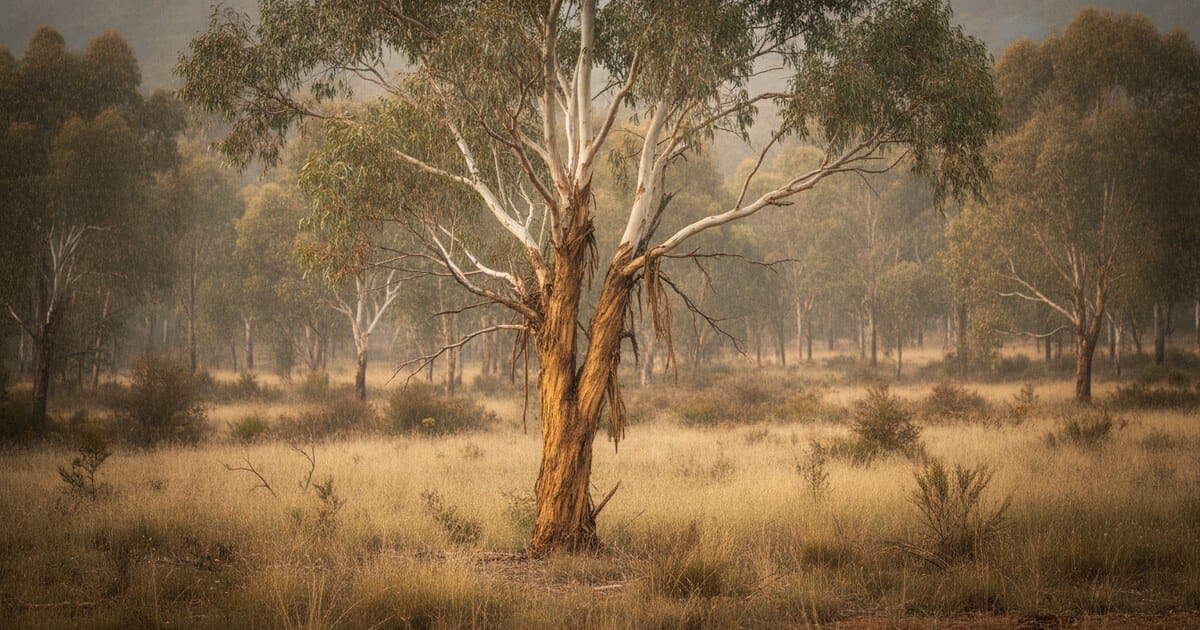
Eucalyptus melliodora, the yellow box tree, grows across the grassy woodlands of south-eastern Australia, filling its habitat with profuse, honey-scented flowers each spring. The name says it plainly: “melli” is Latin for honey, “odora” means fragrant. But getting a confident ID in the field takes more than a sniff.
Yellow box belongs to a loose group called box eucalypts, named for their fibrous, flaky bark. It doesn’t strip in long ribbons like a stringybark or harden into dark ridges like ironbark. What sets yellow box apart is what’s underneath: scratch any rough bark section with a thumbnail and you’ll see vivid yellow-orange inner bark, the same colour that gave this tree its name.
Yellow box tree (Eucalyptus melliodora) is identified by its variable fibrous bark with a bright yellow-orange inner layer, dull grey-green lanceolate leaves 6-14 cm long, buds in clusters of 7, and profuse white honey-scented flowers from September to February. It grows 12-30 metres tall in grassy woodland across Victoria, New South Wales, the ACT, and Queensland’s Darling Downs.
Tree Identifier can confirm yellow box tree identification from a photo of the bark or leaves. The app works offline for bush walks in woodland where cell coverage is thin. 2 free identifications per day, no subscription needed. Download on iOS or Android
Yellow Box Tree at a Glance
The quickest way to build a mental search image for yellow box is a four-point check: bark (fibrous, yellow-brown, vivid yellow inner layer), leaves (small, grey-green, dull), buds (7 per cluster), flowers (white, November peak, honey-scented).
| Feature | Yellow Box |
|---|---|
| Height | 12-30 m |
| Bark (rough zone) | Fibrous, flaky, yellow-brown to yellow-grey |
| Inner bark | Bright yellow-orange when scratched |
| Bark (smooth zone) | Pale grey-cream on upper trunk and limbs |
| Adult leaves | Lanceolate, 6-14 cm × 0.6-3 cm, dull grey-green |
| Buds | Clusters of 7, 0.4-0.8 cm, outer operculum retained until flowering |
| Flowers | White, September-February (peak November) |
| Fruit | Hemispherical to truncate-globose, 0.3-0.8 cm, 4-5 valves |
The term “box” in the name refers to the bark type, not the tree’s shape. Box eucalypts have fibrous, flaky bark that breaks into short irregular pieces. Yellow box, grey box, red box, and white box are all separate species in this bark group.
How to Identify Yellow Box Tree Bark
Bark is the first thing to check, but yellow box has a catch: coverage varies enormously from tree to tree. Some individuals show rough, fibrous bark only at the base, with the upper trunk and limbs smooth and pale grey-cream. Others carry rough bark all the way to the branch forks. A few are rough from base to small branches, with barely a smooth patch in sight.
Yellow box tree (Eucalyptus melliodora) is a medium-to-tall eucalypt growing 12-30 metres, endemic to south-eastern continental Australia. Its bark is the primary identification tool: yellow-brown to yellow-grey fibrous or flaky “box” bark covers the trunk in variable amounts, from base only to the entire trunk. Scratching any rough section reveals a bright yellow-orange inner layer (hence the common name yellow box). The smooth upper trunk and limbs are pale grey to cream. Adult leaves are lanceolate to slightly falcate, 6-14 cm long and 0.6-3 cm wide, dull grey-green and concolorous. Buds appear in axillary clusters of 7 and retain their outer operculum until flowering. White, honey-scented flowers appear September to February, peaking in November. The small fruit are hemispherical to truncate-globose, 0.3-0.8 cm long, with 4-5 valves. The species occurs across Victoria, New South Wales, the ACT, and Queensland’s Darling Downs region, typically in grassy woodland on well-drained soils.
The rough bark itself is fibrous and flaky, shedding in short pieces. The colour runs from yellow-brown to grey-brown, occasionally almost white. When bark sheds and new surface is exposed, the patches left behind appear pale yellow, reinforcing the name from the outside.
The scratch test is the fastest field confirmation. Peel back or scratch lightly with a thumbnail on any rough section. The inner bark is vivid yellow-orange, far more saturated than the outer surface suggests. This colour separates yellow box from grey box and white box, which share the fibrous bark type but have different inner bark colours when scratched.
Leaves, Buds, and Flowers of Yellow Box Tree
The adult leaves are small for a eucalyptus. They’re lanceolate to slightly falcate (curved like a sickle), 6-14 cm long and 0.6-3 cm wide, dull grey-green above and below. “Concolorous” means the top and underside are the same colour, worth noting because some eucalypts have distinctly paler undersides.
Juvenile leaves look quite different: more elliptical to lanceolate, 2.5-6.5 cm long, initially growing in opposite pairs on the stem before shifting to alternate as the tree matures. If you’re looking at young regrowth after fire, the leaves won’t match the adult canopy at all.
The buds cluster in groups of 7 on short axillary stalks. One diagnostic detail: yellow box retains its outer operculum (the outer bud cap) until just before flowering. The inner operculum is conical to rounded or slightly beaked, 0.4-0.8 cm long, green to yellow-cream in colour.
Flowers are white, profuse, and notably honey-scented. Yellow box has the strongest flower scent of any box eucalypt in south-eastern Australia. They appear September to February, peaking in November. The heavy November nectar flow makes yellow box one of the most important honey trees across its range.
Yellow Box Tree Distribution and Habitat
Yellow box grows across a broad arc of south-eastern continental Australia. In Victoria, its range runs from the Western District and Grampians east to the Snowy River country and north through the tablelands. In New South Wales, it’s widespread on the western slopes and tablelands. The species extends into the ACT and into Queensland on the Darling Downs and Consuelo Tableland.
The typical habitat is grassy woodland on lower slopes and rises. Yellow box prefers moderately fertile soils, often sandy or alluvial, that are well-drained but retain some moisture. It tolerates moderate frost and wind, suiting the tablelands where temperatures drop sharply in winter.
Yellow box grassy woodland is listed as critically endangered in New South Wales and the ACT. Land clearing removed most intact stands, leaving scattered remnants across farmland and roadsides. Individual trees are still common; intact woodland communities with their full species complement are rare. For more on identifying Australia’s iconic native trees, our banksia guide covers another genus central to the continent’s native ecosystems.
Yellow Box vs Similar Box Eucalypts
Several box eucalypts share yellow box’s habitat and growth form. These are the most likely sources of confusion.
Grey box (Eucalyptus microcarpa): Very similar fibrous bark, but the inner bark is a paler yellowish-grey rather than the vivid yellow-orange of yellow box. Grey box also has smaller fruit (0.2-0.5 cm vs 0.3-0.8 cm for yellow box). It tends to prefer drier, warmer areas and is more common in western Victoria and southern NSW.
White box (Eucalyptus albens): Has a whitish-grey bloom to its rough bark. The inner bark is paler, and adult leaves are broader and more ovate compared to yellow box’s narrow lanceolate foliage. White box also tends to grow on slightly higher, drier ground.
Red box (Eucalyptus polyanthemos): The fastest separator is leaf shape. Red box has round to broadly ovate leaves, quite different from yellow box’s lanceolate foliage. The rough bark can look similar, but the circular leaves settle the ID quickly.
Yellow gum (Eucalyptus leucoxylon): Shares yellow-toned bark but is smooth-barked over most of the trunk. Buds appear in clusters of 3 (not 7), and the fruit is notably larger.
Black ironbark (Eucalyptus sideroxylon): The ironbark’s deeply furrowed, hard, dark grey-black bark is quite different from box bark once you know the type. Ironbark doesn’t flake and has no yellow inner bark. The two species can hybridize around the Pilliga region of NSW, so intermediate forms appear in that area. Our ironbark tree guide covers the full E. paniculata, E. sideroxylon, and E. crebra complex.
The quickest disambiguation across all box eucalypts is the scratch test: yellow box shows the most saturated, vivid yellow-orange inner bark of any species in the group.
Wildlife Value and Practical Uses
Yellow box is one of the most wildlife-productive trees in south-eastern Australian woodland. The hollows that develop in older specimens provide nesting and roosting sites for owls, cockatoos, rosellas, possums, and bats. These hollow-dependent species are among the most threatened in the region, and old yellow box trees are critical for their survival.
The November flowering season delivers a heavy nectar flow. Beekeepers prize yellow box honey for its pale colour, mild floral flavour, and slow crystallisation. The honey is typically pale yellow-brown. In good flowering years, hives placed in yellow box woodland can be highly productive.
The timber is exceptionally hard and dense, around 1,100 kg/m³. It’s rated durability class 1 (more than 25 years in ground contact), making it suitable for railway sleepers, power poles, and heavy construction. The same hardness that makes it durable makes it difficult to work, though furniture makers value its fine, uniform texture.
Koalas occasionally browse yellow box foliage, though it’s not a preferred food tree the way manna gum or river red gum is.
Frequently Asked Questions
Is yellow box tree rare or endangered?
Eucalyptus melliodora itself isn’t listed as threatened. Yellow box grassy woodland is a different matter: it’s listed as critically endangered in New South Wales and the ACT. Land clearing removed most intact stands, leaving scattered trees across farmland and roadsides. Individual trees are common; intact woodland communities with their full species complement are not.
How fast does yellow box tree grow?
Yellow box has a slow to moderate growth rate and is long-lived. Young trees in reasonable conditions might add 30-50 cm in height per year, but the species isn’t known for fast establishment. Established trees in native woodland can live for 300 years or more, developing the large hollows that hollow-dependent fauna need.
Can you grow yellow box tree in a garden?
Yellow box works well in larger gardens in south-eastern Australia’s cooler, drier zones. It’s drought-tolerant once established, frost-hardy, and attracts native bees, honeyeaters, and lorikeets. Garden specimens typically reach 15-20 m, smaller than the 30 m recorded in native woodland. It needs space and doesn’t suit small suburban blocks.
Why does bark coverage vary so much on yellow box?
Bark coverage in yellow box varies with age, site conditions, and individual genetics. Young trees are often smooth-barked except at the base. As a tree ages, rough bark extends further up the trunk. Drier, harsher sites tend to produce more extensive rough bark; wetter, more sheltered conditions keep coverage limited to the lower trunk.
Tree Identifier can confirm a yellow box identification from a photo of the bark, leaves, or fruit. The app works offline for bush walks in yellow box woodland where cell coverage is thin, returning a species match with confidence score and detailed species notes. Download on iOS or Android, or run a free scan at treeidentifier.app/tools/tree-identifier.
Identify a tree from your photo — free
Upload a leaf, bark, or whole-tree photo and get the species in seconds. No signup.
Confidence:
Unlock the full species profile
Free in the app — with unlimited identifications.


AI result for guidance — the app gives full species details and works offline.
Want unlimited identifications?
Get the full species profile, photos and details — free in the app, with unlimited scans.
- Unlimited identifications
- Full species profiles & details
- Works offline, anywhere
- Save and revisit your finds

Elena Torres
Tree Identifier Team