Illawarra Flame Tree: Leaves, Bark and Identification
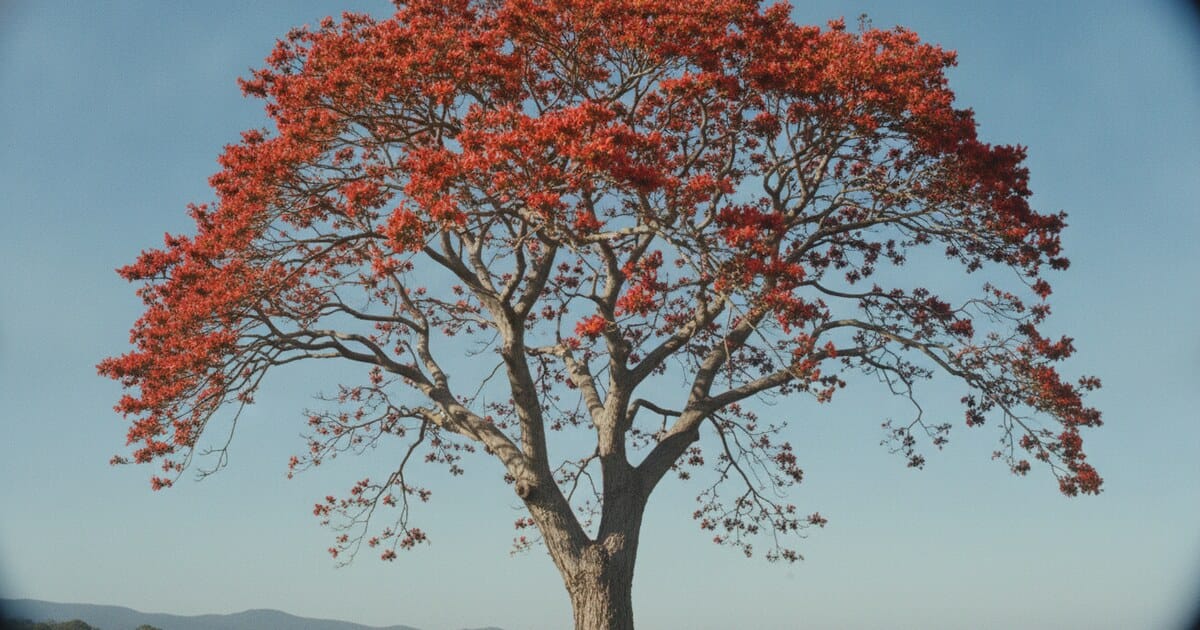
The Illawarra flame tree (Brachychiton acerifolius) earns its name when it blooms. The entire canopy turns bright scarlet while the branches are still bare of leaves, a display so striking along the NSW coast and into Queensland that nothing else looks quite like it. Outside of that flowering window, though, identifying one takes closer attention to leaves, bark, and seed pods.
Leaf shape shifts dramatically with tree age. Young plants grow deeply lobed, maple-like leaves; older trees can carry shallowly lobed or almost oval foliage on the same branches. Add the erratic flowering schedule, where full displays may only happen once every few years, and you can see why this species trips up even experienced naturalists. This guide covers every identification feature so you can confirm what you’re looking at in any season.
The Illawarra flame tree (Brachychiton acerifolius) is a large deciduous Australian native in the family Malvaceae. It reaches 30-35 m in the wild and 10-18 m in cultivation. Leaves are glossy green and highly variable: deeply lobed with 3-5 lobes on young trees, shallowly lobed or oval on mature specimens. Scarlet bell-shaped flowers appear in late spring to early summer while the tree is completely leafless, making it distinctive among eastern Australian rainforest trees.
What Does an Illawarra Flame Tree Look Like?
The Illawarra flame tree forms a broad pyramidal crown when young, gradually rounding out as it ages. In its native subtropical and seasonally dry rainforests along Australia’s east coast, it reaches 30-35 m. Garden specimens in temperate climates are typically 10-18 m at maturity.
Brachychiton acerifolius belongs to the family Malvaceae and is endemic to eastern Australia’s coastal and escarpment rainforests. Its native range spans the Shoalhaven River in southern New South Wales north to Cape York in Queensland, covering lowland rainforest pockets and inland escarpment ranges. The species name acerifolius is Latin for “maple-leaved,” referencing the lobed leaves that resemble Acer species on young trees. In the wild, mature trees reach 30-35 m with an initially pyramidal silhouette that broadens with age. Trunk bark shifts from smooth, shiny grey-green on young stems to greyish-brown and fissured on older trunks. Mature trees tolerate temperatures down to -3.8°C (25°F), extending their range into temperate regions beyond the subtropics. From seed, the tree takes 5-8 years to produce its first flowers. In cultivation it’s been established in temperate gardens across California and South Africa, where it’s planted specifically for the leafless scarlet flowering display.
Leaves
The leaf shape is the trickiest part of this tree’s ID. Young plants put out deeply lobed leaves with 3-5 distinct lobes, each leaf up to 30 cm long and 25 cm wide. That deeply cut, maple-like foliage is exactly what “acerifolius” refers to. Older trees pare down the lobes, often growing shallowly lobed or nearly oval leaves on the same canopy.
Both leaf forms are glossy green on the upper surface, smooth, and arranged alternately along branches. Leaves turn yellow just before they drop in late winter to early spring, leaving the tree bare for several weeks before the flowers open. If you’re looking at a large street tree with oval, barely-lobed leaves and wondering whether it’s a flame tree, check for old seed pods still hanging from the branches from the previous year.
Bark
Young stems and branches have smooth, shiny, bright grey-green bark. Older trunks develop greyish-brown bark with irregular fissures and a rougher texture. The trunk stays roughly cylindrical and doesn’t develop the swollen base seen in some other Brachychiton relatives, such as the Queensland bottle tree (B. rupestris). That cylindrical profile combined with the pyramidal crown is a useful whole-tree identifier outside of flowering season.
Illawarra Flame Tree Flowers: Key Identification Features
The flowers are the clearest identification feature when they’re present. Each bloom is scarlet to coral-red, bell-shaped from the side and star-shaped viewed end-on, with five petals fused at the base and spreading freely at the tips. They measure 25-30 mm long by 16-22 mm wide, with a waxy surface that catches light on bare branches.
Flowers grow in large branching clusters (panicles) at the ends of bare branches, so a flowering tree looks carpeted in red from a distance.
Flowers appear in late spring to early summer in the Southern Hemisphere, roughly November to January. The key timing feature: the blooms arrive while the tree is leafless or nearly so, producing that vivid bare-branches display. A Brachychiton with solid red flowers on bare wood in the Australian spring is almost certainly this species.
The display is famously unpredictable. In a quiet year, only one or two branches may flower while the rest of the canopy stays green. A full, whole-tree flowering event typically follows a hot, dry summer and may only happen every 3-5 years at any given location. The Cold Chisel song “Flame Trees,” referencing trees near Grafton in northern NSW, captures something real about how those peak flowering years stick in memory: they’re genuinely rare when they arrive at full intensity.
Native bees are the primary pollinators, though White-headed Pigeons, honeyeaters, and lorikeets also visit flowering trees. Several native butterfly species use the foliage as a food plant for their caterpillars, including the Pencilled Blue, Helenita Blue, Common Aeroplane, and Tailed Emperor.
Illawarra Flame Tree Seed Pods
After flowering, the tree produces dark brown to black boat-shaped pods roughly 10 cm long. Each pod is tough and leathery, with rows of corn-like yellow seeds packed in fine irritating hairs. When a dry pod splits open, those hairs go airborne easily.
Wear gloves when handling open pods. The hairs cause skin and eye irritation on contact and respiratory discomfort if inhaled in quantity. This is worth knowing before collecting pods for garden planting or ID confirmation.
Pods hang on branches long after seeds disperse, making them a reliable off-season identification feature. A bare tree with those distinctive dark boat-shaped pods left over from the previous season is almost certainly a flame tree, even without leaves or flowers to confirm it.
Aboriginal communities across NSW and Queensland used this tree practically for generations. The seeds, protein-rich and reportedly comparable in taste to raw peanuts, were cooked to neutralize the hairs before eating. The inner bark was stripped and worked into string, fishing nets, and fish traps. Both uses are documented in the ethnobotanical record from coastal and escarpment communities.
Illawarra Flame Tree vs. Kurrajong: Key Differences
“Kurrajong” is a general term applied to several Brachychiton species, which creates regular identification confusion. The most common mix-up is between the Illawarra flame tree (B. acerifolius) and the common kurrajong (B. populneus), particularly outside of flower season.
Flowers are the clearest distinguishing feature when they’re present. Kurrajong flowers are creamy white with a pink or red speckled interior. Flame tree flowers are solid scarlet with no speckled patterning. If you’re looking at flowering branches, there’s no ambiguity.
Leaf-drop behavior differs clearly between the two. The Illawarra flame tree drops its leaves before flowering, producing that bare-branches display. Kurrajong holds its leaves through the dry season. Outside of flower season, habitat context helps: flame tree stays close to wetter coastal rainforest and escarpment zones, while kurrajong is drought-adapted and extends well into the dry inland west of NSW and Queensland.
For other red-flowering Australian natives that might be mistaken at a distance, the waratah (Telopea speciosissima) and grevillea species are easy to separate at close range. Waratah flowers are dense, crimson, upright domes growing directly from the branch rather than hanging bell clusters. Grevillea flowers are toothbrush-style spikes or spider-like arrangements with no resemblance to the bell form at all. Knowing those three species side by side covers the most common red-flowering confusion in eastern Australian bushland.
Identify Any Illawarra Flame Tree Feature With Tree Identifier
Spotting an Illawarra flame tree in full summer bloom is straightforward. Identifying a seedling in a garden, a non-flowering specimen in a suburban street, or a leaf from a fallen branch is harder given how much the foliage varies by age. Tree Identifier’s AI handles all of these: photograph a leaf, a bark section, or a seed pod and get an instant species identification with confidence scores.
The app works on iOS and Android and includes offline identification support, which makes it practical for coastal hikes and rainforest walks where mobile coverage drops out. It covers thousands of Australian native tree species with habitat notes and identification details, so you can work through a full species comparison rather than just getting a single result.
You get 2 free identifications per day. For identifying wood grain from Brachychiton timber, the app’s wood recognition mode works separately from its live tree identification. Or try the browser-based tool at treeidentifier.app/tools/tree-identifier if you want to check a photo without installing anything.
Eastern Australia’s rainforests and escarpment zones hold a lot of spectacular native trees worth knowing. Banksia species and wattle trees are two others that repay close attention when you’re walking the same coastal habitats where flame trees grow.
Frequently Asked Questions
When does the Illawarra flame tree flower?
The Illawarra flame tree flowers in late spring to early summer, roughly November to January in the Southern Hemisphere. The display is erratic: a full whole-tree flowering event typically follows a hot, dry summer and may only peak every 3-5 years at any given location. In quieter years, only a few branches may produce flowers while the rest of the canopy stays green.
How tall does an Illawarra flame tree grow?
In its native subtropical rainforest habitat along Australia’s east coast, the Illawarra flame tree reaches 30-35 m. Garden specimens in temperate climates are considerably smaller, typically 10-18 m at maturity. Trees grown from seed take 5-8 years to produce their first flowers, though grafted nursery stock tends to flower earlier.
What is the difference between an Illawarra flame tree and a kurrajong?
The clearest distinction is flower color: Illawarra flame tree flowers are solid scarlet, while kurrajong (Brachychiton populneus) flowers are creamy white with pink or red speckled interiors. The flame tree also drops its leaves before flowering, while kurrajong holds its leaves year-round. Outside of flower season, habitat helps: flame tree favors wetter coastal and escarpment zones, while kurrajong tolerates much drier inland conditions.
Are Illawarra flame tree seed pods dangerous?
The pods contain fine hairs that cause skin and eye irritation on contact and respiratory discomfort if inhaled. Always wear gloves when handling split pods, and avoid opening them in windy conditions. The seeds themselves have a history of use as food by Aboriginal communities after cooking to neutralize the hairs, but handling the raw pods without protection is genuinely uncomfortable.
Why doesn’t my Illawarra flame tree flower?
Flowering in this species is triggered by environmental stress, particularly hot, dry summer conditions. A tree receiving regular irrigation is less likely to produce a full flowering display than one under moderate moisture stress. Trees grown from seed also require 5-8 years before they flower at all. Individual trees vary in their flowering tendency, which is why one street tree may bloom brilliantly while its neighbor of the same species stays green.
If you’re trying to confirm a tree’s identity from a photo in any season, snap a photo of the leaf, bark, or pods and try the Tree Identifier app. It identifies Australian native trees from a single image and works offline on remote hikes.
Identify a tree from your photo — free
Upload a leaf, bark, or whole-tree photo and get the species in seconds. No signup.
Confidence:
Unlock the full species profile
Free in the app — with unlimited identifications.


AI result for guidance — the app gives full species details and works offline.
Want unlimited identifications?
Get the full species profile, photos and details — free in the app, with unlimited scans.
- Unlimited identifications
- Full species profiles & details
- Works offline, anywhere
- Save and revisit your finds
Elena Torres
Tree Identifier Team