Wollemi Pine: Leaves, Bark and Identification Guide
The Wollemi pine first surfaced on 10 September 1994, when park ranger David Noble abseiled into an unnamed sandstone canyon about 150 kilometers northwest of Sydney and spotted trees with bark unlike anything in any field guide. What he’d found was Wollemia nobilis, a conifer whose pollen matches Jurassic-era fossils from over 200 million years ago, quietly surviving in a gorge nobody had documented before.
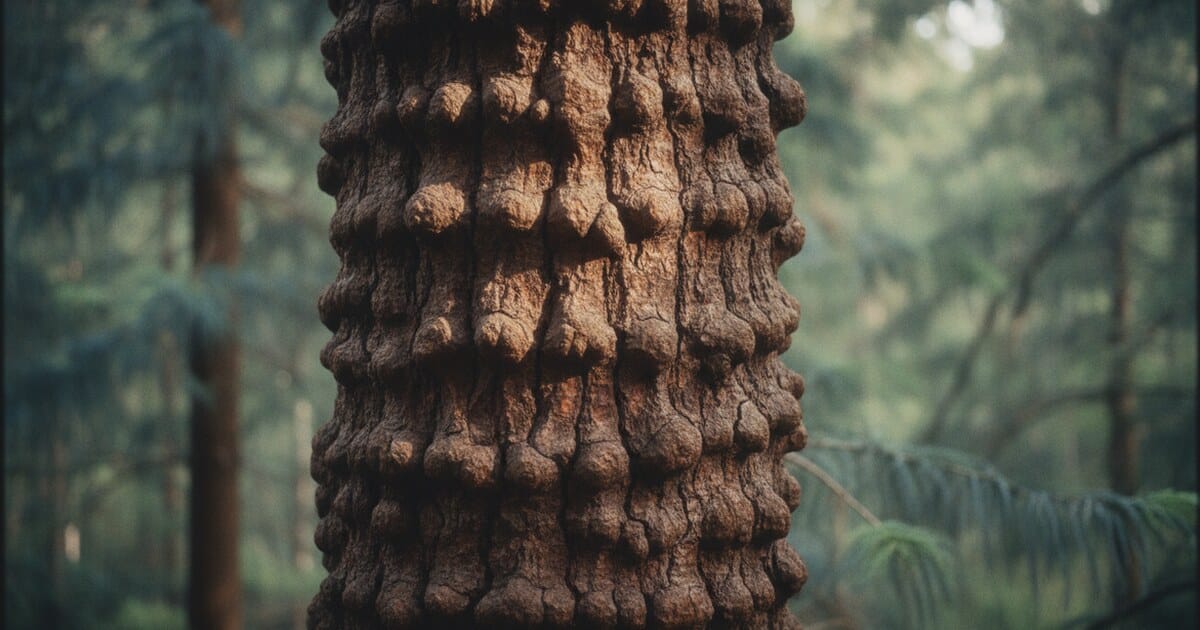
Identifying a Wollemi pine is straightforward once you know the bark. No other tree produces bark that looks quite like bubbling chocolate. Supporting features include flat, fern-like foliage arranged in opposite pairs, a multi-stemmed growth habit unusual in conifers, and waxy white buds streaked with ruby-pink each winter that botanists call polar caps. This guide covers every visual ID feature in detail, from seedling to mature specimen.
The Wollemi pine (Wollemia nobilis) is identified by its chocolate-brown bark covered in spongy, bubble-like nodules. No other tree produces this texture. Supporting features include flat fern-like leaves arranged in two opposite ranks along each branch, multi-stemmed growth from the base, and white waxy polar caps on the buds each winter. It belongs to family Araucariaceae, not the pine family.
What Does a Wollemi Pine Look Like?
A mature Wollemi pine in its native canyon habitat reaches 30-45 meters tall, with some wild specimens measured at 40 meters and trunk diameters up to 1 meter. In gardens and cultivation, most trees grow to 10-15 meters over several decades.
One of the easiest field marks is the growth habit: unlike most conifers, which produce a single dominant trunk, Wollemi pines often push up 2-4 stems from the base. Researchers think this multi-stem pattern developed as a survival strategy in the steep, unstable canyons where wild trees grow, giving each plant redundancy against rock falls and fire damage over centuries of exposure.
The overall silhouette is columnar with branches arranged in tiers, foliage hanging in pendulous sprays. From a distance, younger trees can look vaguely like a Norfolk Island pine (Araucaria heterophylla) or a bunya pine (Araucaria bidwillii); all three belong to Araucariaceae and share that stacked, layered crown. Up close, the bark and foliage detail resolve the ID immediately.
Wollemia nobilis belongs to the ancient conifer family Araucariaceae, which also includes the Norfolk Island pine, monkey puzzle tree (Araucaria araucana), and bunya pine. The genus Wollemia contains just one species. Wild trees grow in 4 small groups within a single canyon system in Wollemi National Park, New South Wales, at altitudes between 670 and 780 meters. A 2020 population census counted 89 wild plants total, of which 46 were mature adults. Molecular analysis has shown that all wild trees share identical DNA, making the entire wild population a single clonal organism. Pollen grains matching Wollemia date back over 200 million years to the Jurassic period, giving this species one of the longest-documented lineages of any surviving tree on Earth. Since commercial propagation programs launched in the early 2000s, Wollemi pines now grow in botanical gardens across more than 30 countries.
For anyone exploring Australian forests and coming across unfamiliar native trees, the site also covers banksia, casuarina, and other distinctive species from the same region.
How to Identify Wollemi Pine Bark
The bark is the single most reliable identification feature, and it’s the one that stopped David Noble mid-abseil in 1994. Wollemi pine bark forms thick, chocolate-brown, rounded nodules that stack up over the trunk and older branches like hardened chocolate foam. No other tree species produces this texture.
The nodules are corky and slightly spongy when pressed. On very young trees (seedlings and saplings under 2-3 meters), the bark starts smoother, and the nodule pattern builds as the stem thickens. By the time a cultivated tree reaches 4-5 meters, the bubbly texture is unmistakable in any light.
Bark color varies slightly with age and moisture. Fresh growth sections tend toward reddish-brown. Older established bark on the main trunk reads as a darker, drier chocolate-brown. After rain, wet bark deepens in color and the nodule pattern becomes even more pronounced.
One practical comparison helps: the bark of Norfolk Island pine and bunya pine is plated and fibrous, with long vertical furrows typical of Araucariaceae. Wollemi pine bark is none of those things. The nodule pattern is structurally different from any other conifer in cultivation, which makes it genuinely useful as a standalone identifier even in a mixed planting.
Wollemi Pine Leaves, Cones, and Polar Caps
The leaves are flat and narrow, each about 3-8 centimeters long, and they grow in two opposite ranks along every branch. This creates a layered, fern-like appearance entirely different from the needle clusters (fascicles) of true pines. Touch the needles and they’re soft and flexible. Sharp needles are a feature of other conifers, not this one.
Leaf color shifts with age. New spring growth flushes light apple-green to yellow-green. As leaves mature over the season, they darken to a rich blue-green. A single branch shows both shades simultaneously where older and newer growth coexist, giving the foliage an iridescent, layered quality in good light.
Polar caps are the winter ID feature nobody else covers, and they’re essentially a diagnostic on their own. Each winter, the growing tips of Wollemi pines produce compact white waxy coatings striped with ruby-pink that protect the dormant buds from cold and desiccation. No other Araucariaceae member does this. If you spot white-capped bud tips on a multi-stemmed columnar conifer in winter, you’re looking at a Wollemi pine.
Cones confirm the ID. Wollemi pines are monoecious, so male and female cones appear on the same tree. Female cones are rounded, reaching about 7-8 centimeters long, starting green and maturing to brown as seeds develop. Male cones are narrower, reddish-brown, and reach about 10 centimeters. Female cones sit at the growing tips; male cones hang lower on the same branches.
The 1994 Discovery: A Tree That Outlived the Dinosaurs
The discovery started as an ordinary weekend trip. Noble was canyoning with two companions through an unnamed gorge in Wollemi National Park on 10 September 1994. He spotted trees with bark he couldn’t place. The bubbly chocolate texture didn’t match any species he knew.
He collected leaf samples and carried them out, initially not flagging it as especially significant. A few days later he showed the leaves to botanist Jan Allen, who recognized the foliage as Araucariaceae but couldn’t pin the genus. The samples went to Sydney’s Royal Botanic Garden. Botanists there confirmed a completely new genus, unknown to science: not just a new species, but a whole new branch of the family tree.
The genus was named Wollemia after the national park. The species epithet nobilis honors Noble himself. Fossil pollen matching the tree traced back over 200 million years, and fossil leaf impressions resembling the bark were already known from 90-million-year-old deposits. Botanists had studied those fossils assuming the lineage had died out. The living trees proved otherwise.
Grevillea species in the same region were known to science decades earlier. Wollemi pine’s late discovery came down to pure inaccessibility: the canyon system is bounded by sheer sandstone cliffs, and before Noble’s abseil it had simply not been explored at ground level. For a guide to another distinctive Australian native, see the grevillea identification guide.
Conservation: Why the Location Is Secret
The NSW government classifies the canyon coordinates and controls public access. Two reasons drive that decision.
First, Phytophthora cinnamomi (the root rot pathogen responsible for large-scale dieback across Australian eucalypt forests) spreads through soil on footwear. Unauthorized visitors to the site could introduce it, and the Wollemi pine population has no demonstrated resistance.
Second, the population’s genetic uniformity makes it unusually fragile. The 2020 census counted 89 plants across four groups, all sharing identical DNA. A single pathogen to which they have no resistance could theoretically eliminate the entire wild population in one outbreak.
The propagation response to that risk has been extensive. Starting in the early 2000s, Australian botanical institutions began distributing Wollemi pines to collections and commercial nurseries worldwide. Trees now grow at Kew Gardens, the Royal Botanic Gardens in Edinburgh, and botanical gardens across North America, Europe, and Asia. The ex-situ population now numbers in the tens of thousands. Anyone wanting to grow a Wollemi pine can buy one from specialty nurseries in Australia, the UK, the US, and Europe. No canyon access required.
Identifying Wollemi Pines With Tree Identifier
Spotting a Wollemi pine in a botanical garden is satisfying once you know the bark. Identifying unfamiliar Australian conifers or native species in the bush is harder, especially with younger trees where the bark hasn’t fully developed its nodule pattern.
Tree Identifier’s AI photo recognition covers thousands of native Australian species, including Araucariaceae members such as bunya pine, hoop pine, and Norfolk Island pine alongside Wollemi pine. Point the camera at bark, a branch with foliage, or the full tree silhouette; the app cross-references multiple visual features from a single shot and returns an identification with species details, habitat information, and key distinguishing features.
The app works offline, so it’s useful on remote hikes where canyon walls cut mobile signal. Two free identifications per day with no subscription needed to start.
Try Tree Identifier the next time you’re in a botanic garden or walking through Australian bush. Snap a photo of the bark or foliage, and you’ll have the species confirmed in seconds.
Frequently Asked Questions
Is the Wollemi pine a real pine?
The Wollemi pine isn’t a true pine. True pines belong to the family Pinaceae and the genus Pinus, while Wollemia nobilis belongs to Araucariaceae: the same family as Norfolk Island pine, monkey puzzle tree, and bunya pine. The “pine” in the common name refers to its conifer-like silhouette, not any formal botanical relationship. Calling it a pine is like calling a koala bear a bear.
Why is the Wollemi pine called a dinosaur tree?
The nickname comes from the fossil record. Pollen grains matching Wollemia date back over 200 million years, meaning ancestors of this tree coexisted with dinosaurs during the Jurassic period. Botanists already knew these fossils before 1994; they assumed the lineage had long gone extinct. Finding living specimens in a hidden Australian canyon was effectively discovering a living fossil that survived two mass extinctions.
Why is the Wollemi pine’s location kept secret?
The NSW government classifies the canyon coordinates to prevent introduction of Phytophthora cinnamomi, a soil-borne root rot pathogen that spreads on footwear. The wild population (89 plants, all genetically identical) would have little resistance if the pathogen established in the gorge. Wollemi pines are sold commercially and widely grown in cultivation, so the secrecy protects wild trees without limiting public access to the species.
How do I identify a Wollemi pine?
Start with the bark: chocolate-brown rounded nodules stacked over the trunk like solidified foam bubbles. No other tree produces this texture. Then check the foliage: flat, soft needles arranged in two opposite ranks along each branch, creating a fern-like layered appearance. In winter, look for white waxy polar caps on the growing tips, streaked with ruby-pink. Multi-stemmed growth from the base is also characteristic.
Can I grow a Wollemi pine at home?
Wollemi pines are available from specialty nurseries in Australia, the UK, the US, and Europe. They prefer slightly acidic, free-draining soil with filtered sun or morning sun and afternoon shade. Established trees handle light to moderate frosts; container growing works well in colder climates. Growth is slow. Garden specimens typically reach 10-15 meters over several decades. They’re well-suited to large gardens or as a specimen tree in a sheltered courtyard.
Identify a tree from your photo — free
Upload a leaf, bark, or whole-tree photo and get the species in seconds. No signup.
Confidence:
Unlock the full species profile
Free in the app — with unlimited identifications.


AI result for guidance — the app gives full species details and works offline.
Want unlimited identifications?
Get the full species profile, photos and details — free in the app, with unlimited scans.
- Unlimited identifications
- Full species profiles & details
- Works offline, anywhere
- Save and revisit your finds
Elena Torres
Tree Identifier Team