How to Identify Oak Wood: Grain, Rays and Key Tests
Oak is the most common hardwood in North American furniture, flooring, and cabinetry, which also makes it one of the most commonly misidentified. Ash, chestnut, and hickory all share a similar ring-porous structure, and they can fool you at a glance. Knowing how to identify oak wood comes down to three definitive features: end grain pore pattern, medullary ray flecks, and the tyloses test that separates white oak from red. This guide covers each method with the specific details you need to make a confident call.
Oak wood is identified by three features: large open ring-porous pores on end grain visible without magnification, prominent medullary ray flecks on quartersawn surfaces, and coarse straight grain. White oak has tyloses that seal the pores, making it water-tight; red oak lacks them. Janka hardness for both species: 1,290-1,360 lbf.
What Does Oak Wood Look Like?
Oak has a coarse, open grain, the kind where you can feel the texture with a fingertip on a planed surface. The color ranges from pale tan to medium brown, often with a warm golden cast in older pieces. Red oak leans toward pinkish-brown tones in the heartwood; white oak runs cooler, with olive or gray undertones.
The surface grain follows a straight, regular pattern with very few knots under normal growth conditions. On flatsawn boards you’ll see the classic cathedral arch figure of growth rings. On quartersawn boards the grain runs nearly parallel, and that’s where oak’s most distinctive visual feature shows up: the ray fleck.
Oak (Quercus spp.) belongs to the beech family Fagaceae, with roughly 500 species worldwide and about 90 native to North America. As a ring-porous hardwood, oak produces its largest pores during spring earlywood growth and smaller pores in latewood, creating a visible banding pattern on every face. Red oak (Quercus rubra) has a Janka hardness of 1,290 lbf and a density of about 45 lbs/ft³. White oak (Quercus alba) reaches 1,360 lbf and 47 lbs/ft³. Medullary rays in oak run perpendicular to the growth rings and are unusually wide compared to most hardwoods; white oak rays average 0.5-1.0 mm wide and up to 25 mm long on quartersawn faces, while red oak rays are narrower and typically 5-10 mm long. The tyloses compound, a bubble-like growth that fills pores in white oak heartwood, makes it water-resistant, which is why coopers use white oak for whiskey barrels and why red oak barrels leak.
How to Identify Oak Wood on End Grain
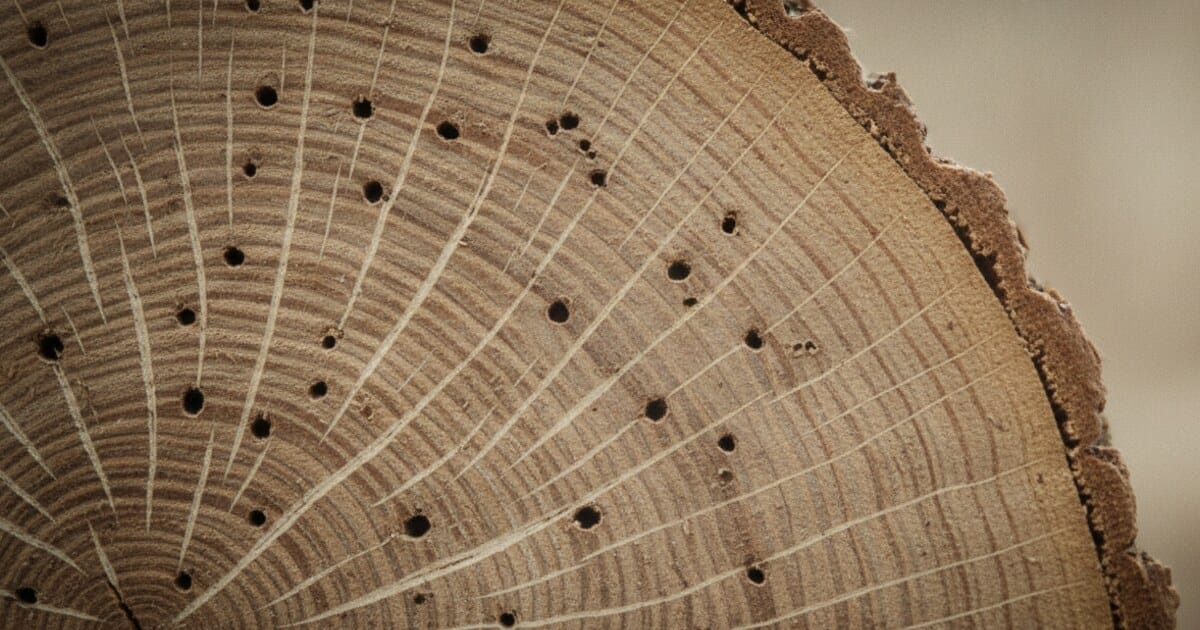
The end grain is the most reliable surface for wood identification, and oak has one of the most recognizable patterns of any hardwood. Look at the cut end of a board or the top of a log cross-section: you’ll see large, open pores arranged in a distinct ring-porous pattern. The spring pores are wide enough to see clearly without magnification, which alone rules out maple, cherry, and birch: those are diffuse-porous and show uniformly tiny pores.
The latewood pores (those formed in summer) are smaller but still visible, arranged in wavy, flame-like bands between the growth ring lines. This combination of large spring pores followed by smaller latewood pore bands is the ring-porous signature. Very few North American hardwoods share it: ash, hickory, and chestnut are the main ones.
With oak, you can also see the medullary rays as lines radiating outward from the center of the log on end grain. On end grain they look like spokes crossing the growth rings. On edge grain they’re less prominent, but on a quartersawn face they open into flecks that make quartersawn oak unmistakable.
To get a clean read, sand or plane a small section of end grain to around 220-grit. A sharp chisel or a few passes of a hand plane works too. The pores and rays show up far more clearly on a smooth surface than on a rough saw cut.
Medullary Rays: Oak’s Most Distinctive Feature
Every hardwood has medullary rays, but oak’s are unusually wide. On a quartersawn oak board (one where the growth rings run nearly perpendicular to the face) the rays catch light and show up as shiny, irregular patches called ray fleck or silver grain. The flecks range from a few millimeters to over 2 cm long on white oak, depending on how close to true quartersawn the cut is.
No other common North American hardwood produces ray fleck this prominent. Ash has rays too, but they’re far narrower and barely visible to the naked eye on edge grain. This makes the ray fleck test close to definitive: if a quartersawn board shows bold, metallic-looking patches and the end grain shows ring-porous pores, you’re looking at oak.
The flecks show up best on freshly planed or sanded surfaces under raking light. Hold the board at a low angle to a light source and tilt it slowly. If you see irregular silver or tan patches glinting across the surface, that’s your ray fleck. On antique furniture the fleck is often the reason a piece was finished in a certain orientation: quartersawn oak was fashionable in Arts and Crafts pieces precisely because of this figure.
For a deeper look at how grain structure helps identify wood species more broadly, the guide on how to identify wood by grain covers the same principles across oak, walnut, maple, and other common species.
Red Oak vs White Oak: How to Tell Them Apart
Red oak and white oak look similar enough that they get confused even in lumber yards. Four tests separate them reliably.
Color: Red oak heartwood has a pinkish-red cast, especially in a fresh cut. White oak is cooler, tannish-brown with olive or gray tones. This isn’t reliable on aged or finished pieces, but on raw wood it’s usually clear.
Ray length: White oak rays are wider and longer than red oak rays, especially on quartersawn surfaces. White oak rays appear as long, thin lines up to 25 mm; red oak rays are shorter, typically 5-10 mm.
Tyloses test: This is the most reliable separator when you have a fresh end grain surface. Blow through a short block lengthwise: air won’t pass through white oak because tyloses seal the pores. Red oak is open enough that you can push air through. A simpler version at home: drop water on the end grain. White oak absorbs it slowly; red oak soaks it up fast.
Pore visibility: Under a 10x loupe, red oak pores appear clearly open. White oak pores look partially or fully blocked because tyloses fill the vessels. If your loupe is handy, this is a 30-second definitive test.
For a side-by-side look at how oak compares structurally to another popular hardwood, the oak vs walnut wood article breaks down grain, hardness, shrinkage, and price.
Simple Field Tests for Identifying Oak Wood
When you can’t get a clean end grain view, four quick tests carry most of the weight.
Weight test: Both red and white oak run 45-47 lbs/ft³. Pick up a board and compare it to something you know: oak should feel noticeably heavier than pine, poplar, or basswood of the same size, about on par with hard maple and slightly heavier than cherry.
Smell: Freshly cut or freshly sanded oak has a distinct tannic smell, sharp and slightly sour, sometimes described as strong tea or mild vinegar. Tannins are what give oak its natural durability, and you can smell them. Ash (a common mix-up) smells more neutral; hickory sometimes has a faint smoky scent when freshly cut.
Fingernail test: Try to dent the wood surface with a thumbnail. Oak resists it clearly at 1,290-1,360 Janka. Softer woods like pine and poplar show a dent; ash and hickory hold like oak does, so this test confirms hardwood class but won’t separate oak from ash.
Surface texture: Run a fingertip across a planed surface. Oak feels coarser than maple or cherry because of the open ring-porous structure. The pore channels are wide enough to catch your skin slightly as you drag across the grain, something maple’s diffuse pores don’t produce.
The general wood identification guide explains how to combine these tests with end grain analysis for species you’re less familiar with.
How Tree Identifier Can Help
If you’re working with an unfinished piece and want a second opinion, the Tree Identifier app includes wood type recognition from photos. Photograph the end grain or a planed face in good lighting, and the AI identifies the species based on grain pattern, pore structure, and texture, the same markers covered above. The app works on oak, walnut, maple, teak, and dozens of other common species.
A clean end grain shot gives the best result. Shoot under natural light or a bright lamp at a slight angle to the surface so the pores show clearly. If you can photograph both the end grain and the face grain, the AI has more signals to work with.
Try the web tool at treeidentifier.app/tools/wood-identifier for one free scan per visit with no account required, or download the app for up to 2 free wood identifications per day.
Frequently Asked Questions
How can I tell oak from ash wood?
Both are ring-porous hardwoods with similar pore banding on end grain, but ash’s medullary rays are barely visible even under a loupe, while oak’s are prominent on quartersawn surfaces. Ash also lacks the tannic smell and has a slightly finer, more uniform grain. The ray fleck test is the fastest separator: quartersawn ash has virtually no fleck; quartersawn oak shows obvious metallic patches.
Does oak have a distinctive smell?
Yes. Freshly cut or sanded oak smells of tannins: a sharp, slightly sour scent similar to strong tea or mild vinegar. The smell fades once the wood is fully dried and finished, so it’s most useful on raw or freshly worked stock. It’s one of the few quick tests that doesn’t require an end grain view.
What is the medullary ray fleck on oak?
Medullary rays are ribbon-like structures running perpendicular to the growth rings, carrying nutrients from bark to the tree’s core during growth. On quartersawn oak boards they appear as bright, irregular patches called ray fleck or silver grain. Oak’s rays are far wider than most hardwoods (up to 25 mm on white oak), making this fleck a reliable visual identification marker.
Is quartersawn oak easy to identify?
Quartersawn oak is one of the easiest woods to identify. The ray fleck is dramatic and unmistakable: shiny, irregular patches across a flat board surface with near-parallel grain lines. Rift-sawn oak (angled between flat and quartersawn) shows a more linear ray pattern with less obvious fleck. Both are far more distinctive than quartersawn ash or maple.
Can you identify oak by color alone?
Color alone isn’t reliable, especially on aged, stained, or finished wood. A fresh cut gives useful clues: red oak shows pinkish-brown heartwood; white oak runs cooler with olive or tan tones. But color varies with age, finish, and light exposure. Use color as a first indicator, then confirm with end grain pore structure and the medullary ray check.
Identify a tree from your photo — free
Upload a leaf, bark, or whole-tree photo and get the species in seconds. No signup.
Confidence:
Unlock the full species profile
Free in the app — with unlimited identifications.


AI result for guidance — the app gives full species details and works offline.
Want unlimited identifications?
Get the full species profile, photos and details — free in the app, with unlimited scans.
- Unlimited identifications
- Full species profiles & details
- Works offline, anywhere
- Save and revisit your finds
Elena Torres
Tree Identifier Team