Australian Native Trees: An Identification Guide to 17 Species
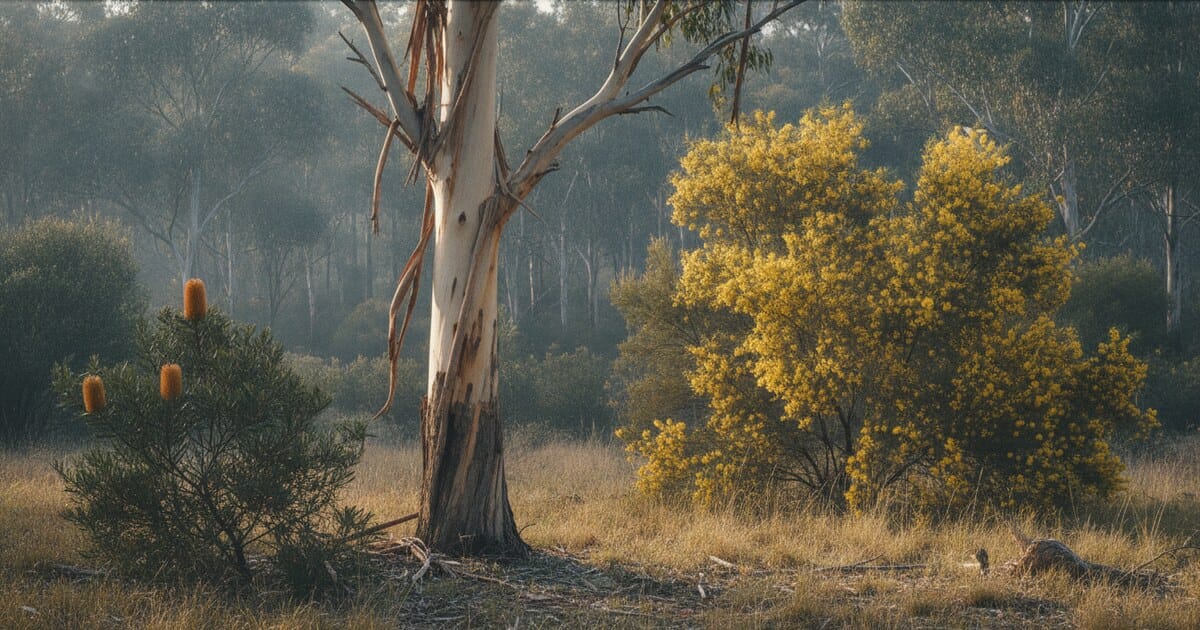
Walk through any patch of Australian bush and you’ll notice the trees don’t follow the rules you learned elsewhere. Leaves hang edge-on to the sun. Bark peels off in ribbons, sheets, or paper-thin layers. Flowers look like brushes, pincushions, or spiders. Australian native trees evolved in isolation for millions of years, and that’s exactly what makes them easier to identify once you know the handful of plant families behind most of what you see.
This guide groups 17 native species into five families and types, gives you the fastest field features for each, and links to a full identification guide for every one. It also covers two non-native trees that turn up in almost every Australian garden, so you don’t mistake them for locals.
To identify Australian native trees, start with the bark and the flowers. Smooth, shedding bark in patches usually means a gum (Eucalyptus or Corymbia). Fluffy yellow ball or rod flowers mean a wattle. Cylindrical flower spikes or woody “cones” point to banksias, and papery, layered bark means a paperbark (Melaleuca).
Gum Trees (Eucalyptus and Corymbia)
Gums are the backbone of the Australian landscape. There are more than 700 eucalypt species, and nearly all of them are native to Australia. Most have tough, drooping, lance-shaped adult leaves that smell of eucalyptus oil when you crush them, and flowers made of a mass of stamens bursting from a cap-shaped bud.
The quickest way to separate gums is bark. Gum trees are identified by their aromatic, often drooping leaves, cap-covered flower buds that open into fluffy stamen flowers, and woody gumnut fruits. Bark type then narrows it down. Smooth-barked gums shed in strips or patches, revealing fresh white, cream, grey, or pink bark underneath, while “boxes,” “stringybarks,” and “ironbarks” keep rough bark on the trunk. Juvenile leaves often look completely different from adult leaves, round and bluish on young growth versus narrow and green on mature branches, so always check leaves from the upper canopy. Location helps too: river red gums line inland waterways, snow gums grow near the treeline in the high country, and spotted gums are a coastal species of New South Wales and Queensland.
- River red gum (Eucalyptus camaldulensis): the most widespread eucalypt in Australia. Look for a massive, often crooked trunk beside a river or creek, with smooth white, grey, and reddish patches of bark.
- Snow gum (Eucalyptus pauciflora): the gum of the alpine high country. Twisted, multi-stemmed trunks with smooth bark streaked in cream, grey, olive, and red.
- Spotted gum (Corymbia maculata): tall and straight, with smooth bark shedding in small patches that leave a dappled, spotted pattern.
Wattles (Acacia)
Australia has roughly 1,000 Acacia species, and golden wattle is the national floral emblem. Most wattles don’t have true leaves as adults. What looks like a leaf is usually a phyllode, a flattened leaf stalk. Flowers are tiny and grouped into fluffy yellow or cream balls or rod-shaped spikes, followed by flat seed pods.
- Golden wattle (Acacia pycnantha): curved, sickle-shaped phyllodes and masses of bright golden ball flowers in late winter and spring.
- Black wattle (Acacia mearnsii): feathery, fern-like bipinnate leaves instead of phyllodes, and pale yellow to cream flowers.
- Wattle trees in general: how to tell phyllode wattles from feathery-leaved wattles, and how to use flower shape and pods.
Banksias, Waratahs, Grevilleas, and Macadamias (Proteaceae)
The protea family is ancient and mostly southern-hemisphere. Its Australian members produce some of the continent’s most striking flowers, and the flower is usually the fastest ID feature.
- Banksia: cylindrical flower spikes made of hundreds of tiny flowers, which age into woody “cones” studded with seed follicles. Leaves are often stiff and saw-toothed.
- Waratah (Telopea speciosissima): the floral emblem of New South Wales. A large, dome-shaped red flower head ringed by red bracts in spring.
- Grevillea: spider-like or toothbrush-shaped flower clusters with long, curling styles. Around 360 species, from ground covers to tall trees.
- Macadamia: a subtropical rainforest tree with glossy, leathery leaves arranged in whorls of three or four, long hanging flower strands, and round green husked fruit.
Lilly Pillies, Paperbarks, and Bottlebrushes (Myrtaceae)
These are relatives of the gums, but they look nothing like them from a distance.
- Lilly pilly (Syzygium): dense, glossy leaves in opposite pairs, new growth flushing pink or red, fluffy white flowers, and bright pink, purple, or white berries. A favorite hedge plant.
- Melaleuca: the paperbarks. Thick, spongy bark that peels off in soft, papery layers you can press with a finger, plus bottlebrush-style flowers.
- Bottlebrush (Callistemon, many now classified as Melaleuca): the classic red “brush” flower spike, with new leafy growth continuing from the tip of the spike.
Rainforest Giants and Living Fossils
- Moreton Bay fig (Ficus macrophylla): a huge spreading tree with buttressed roots and large glossy leaves that are rusty-brown underneath. Often starts life as a strangler on another tree.
- Illawarra flame tree (Brachychiton acerifolius): drops many of its lobed leaves in late spring, then covers bare branches in scarlet bell-shaped flowers.
- Wollemi pine (Wollemia nobilis): discovered in 1994 in a remote gorge in the Wollemi National Park, with fewer than 100 mature trees in the wild. Its knobbly, bubbly bark and dark, flat needle-like leaves make it distinctive in gardens.
- Casuarina (she-oaks): drooping grey-green “needles” that are really jointed branchlets, and small woody cones. Not a pine and not an oak.
Common Non-Native Trees in Australian Gardens
Two popular garden trees fool a lot of people because they’re everywhere in Queensland and New South Wales suburbs. Neither is native to Australia.
- Frangipani (Plumeria): from tropical Central America. Thick, blunt branches, large leaves clustered at the branch tips, and fragrant five-petalled flowers.
- Poinciana (Delonix regia): from Madagascar. A wide umbrella canopy of feathery leaves that turns flame-red with flowers in summer, followed by long, flat, dark seed pods.
How Tree Identifier Helps in the Bush
Many Australian trees change shape as they age, and gum species in particular are notoriously hard to separate. Tree Identifier lets you photograph the leaves, bark, flowers, or fruit and get a species identification in seconds, with a confidence score so you know how sure the result is.
A few tips for better results with native trees:
- Photograph the bark at chest height and the leaves from a mature branch, not juvenile regrowth
- Include gumnuts, pods, or flower spikes when you find them, since they separate close species fast
- Download species data before a remote bushwalk and use offline mode where there’s no signal
You get 2 free identifications a day in the app, with no signup needed. You can also try a single free scan in your browser with the online tree identifier.
Frequently Asked Questions
What is the most common native tree in Australia?
Eucalypts are the most common native trees in Australia, dominating most forests and woodlands across the continent. The river red gum is the most widespread single eucalypt species, growing along inland rivers in every mainland state.
Is a gum tree the same as a eucalyptus?
Mostly, yes. “Gum tree” is the common name for eucalypts, which include the genera Eucalyptus, Corymbia, and Angophora. Spotted gum, for example, is a Corymbia, while river red gum and snow gum are Eucalyptus species.
How can I tell a wattle from other yellow-flowering trees?
Look closely at the flowers and leaves. Wattle flowers are tiny and packed into fluffy balls or rod-shaped spikes, and most wattles have flattened phyllodes instead of true leaves. Flat bean-like seed pods after flowering confirm it.
Are frangipani and poinciana native to Australia?
No. Frangipani comes from tropical Central America and poinciana from Madagascar. Both are widely planted in warmer parts of Australia, which is why they’re so often mistaken for native trees.
Start With Bark and Flowers
Most Australian native trees fall into a few families, and bark plus flowers will get you to the right one quickly: shedding bark for gums, fluffy balls for wattles, spikes and cones for banksias, papery layers for paperbarks. Use the species guides linked above to go from family to species, and if you’re standing in front of a tree you can’t place, Tree Identifier can give you an answer from a single photo.
Identify a tree from your photo — free
Upload a leaf, bark, or whole-tree photo and get the species in seconds. No signup.
Confidence:
Unlock the full species profile
Free in the app — with unlimited identifications.


AI result for guidance — the app gives full species details and works offline.
Want unlimited identifications?
Get the full species profile, photos and details — free in the app, with unlimited scans.
- Unlimited identifications
- Full species profiles & details
- Works offline, anywhere
- Save and revisit your finds
Elena Torres
Tree Identifier Team